The Industrial Fire Watch / Jun 15, 2026
Can Your Site See Heat Before Storage Turns Into Smoke?
A dated Fire Watch briefing on warehouse, yard, fuel-point, and electrical-room fires documented on June 15.
What To Know
AVIAN tracked 16 fire and explosion incidents on June 15, 2026 across warehouses, yards, storage zones, and adjacent support spaces. These incidents included 5 reported injuries and 2 reported fatalities across 8 countries.
The shared pattern was not one commodity. It was the type of space: scrap piles, warehouses, battery and plastics storage, electrical rooms, and fueling-adjacent work areas turned small heat or ignition problems into smoke, evacuation, or sitewide disruption.
For operations leaders, EHS teams, maintenance managers, and insurers, the lesson is simple: storage and support areas cannot be treated as passive space. These are often the places with mixed fuel loads, weaker supervision, and the longest gap between the first abnormal condition and a human response.
16
Incidents
8
Countries
5
Injuries
2
Fatalities
Key Incidents
Logistics facility explosion in Miami-Dade County, USA
- Event
- Local 10 reported that an explosion and fire at the Miami-Dade Fire Rescue logistics and fleet fueling-maintenance facility at 6100 SW 87th Avenue killed one person and injured four others. Officials reported heavy damage around a fuel pump and investigated underground vapor or a gasoline vault.
- Risk signal
- Fuel handling, vapor accumulation, and maintenance-adjacent work can create blast consequences before a fire looks large from outside.
- Business impact
- Fatal worker loss, multiple injuries, damage to fleet-support infrastructure, investigation, and disruption to emergency-service logistics and fueling operations.
Firecracker manufacturing unit explosion in Devti village, India
- Event
- Times of India reported that a powerful explosion and fire tore through a licensed firecracker manufacturing unit in Devti village around noon, killing one woman and injuring one man. Officials said the site had separate manufacturing, raw-material, and storage rooms.
- Risk signal
- Stored energetic material and room-to-room separation help only if heat or ignition is caught before it reaches the inventory.
- Business impact
- Fatality, injury, shutdown, police scrutiny, license review, and community disruption around an explosives-handling site.
Recycling pile fire in Flowood, USA
- Event
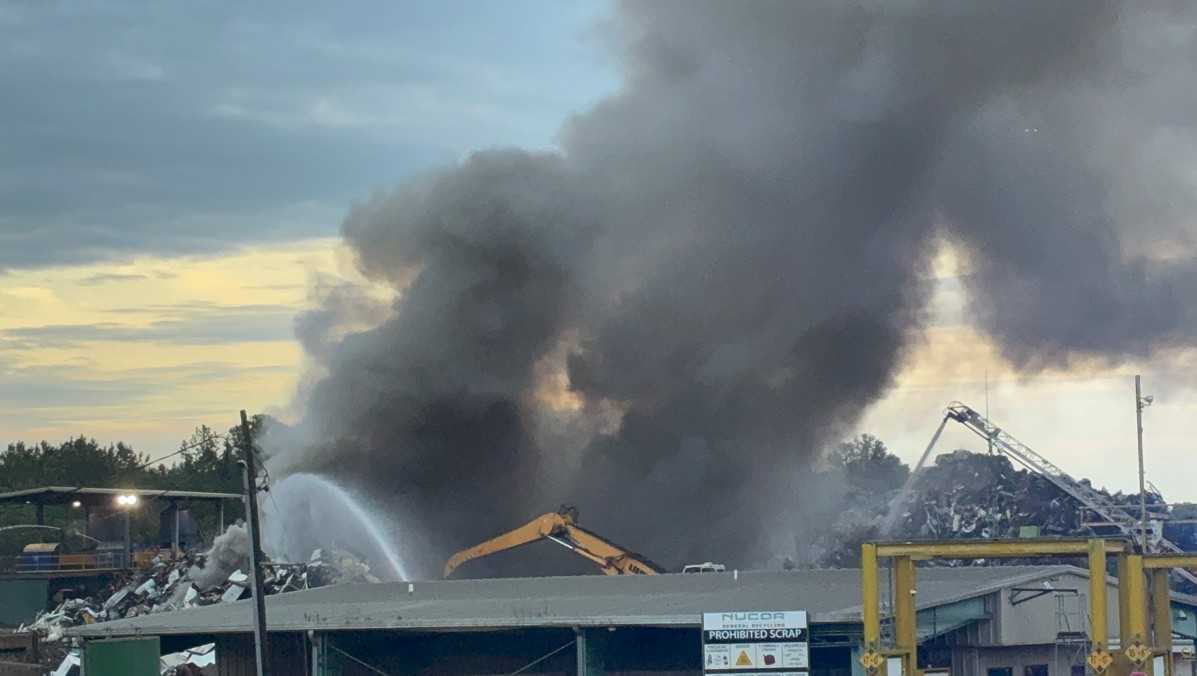
- WAPT reported that a fire broke out around 5:30 a.m. in a pile of unprocessed recycling material including appliances and plastics at Nucor General Recycling in Flowood, sending heavy smoke and flames over the facility for more than two hours. No injuries were reported.
- Risk signal
- Mixed piles and appliance-battery contamination can hide heat deep in material until the visible event is already large.
- Business impact
- Extended firefighting response, likely interruption to intake and sorting work, cleanup of scorched material, and smoke burden on the surrounding area.
Storage warehouse fire in Neumuenster, Germany
- Event
- Presseportal reported that a large fire broke out in a storage warehouse in Neumuenster's Industriegebiet Sued where electrical goods, batteries, and plastics were stored. Around 100 responders were deployed, three people were medically evaluated, and no one was transported to hospital.
- Risk signal
- Mixed storage with batteries, plastics, and electrical goods creates a harder fire load and raises the chance that ignition starts inside stored material, not on an open process line.
- Business impact
- Large-scale emergency response, likely business interruption, inventory exposure, and restart uncertainty while the site is assessed.
Field Note
Storage Space Needs Its Own Detection Discipline
Storage and support-space fires often start outside the core production machine. Warehouses, scrap yards, battery staging, electrical rooms, and fueling areas carry dense fuel loads, variable housekeeping, and longer dwell times. Once smoke is obvious, teams are already in response mode.
Three Risk Signals
Warehouse layout multiplies fire spread
NFPA notes that warehouse contents, layouts, storage configuration, and fuel loads are conducive to fire spread and can make manual suppression harder once the event is established.
Vapors fail before flames are obvious
OSHA's flammable-liquids rule treats ventilation and ignition control as core fire-prevention measures because dangerous vapor-air mixtures can form well before operators see a visible fire.
Battery and mixed-recycling loads need segregation and inspection
EPA recommends isolating terminals, preventing battery damage, storing batteries in ventilated spaces away from occupied areas when possible, adding advanced detection and suppression, and conducting frequent visual and thermal inspections.
Technologies That Close The Gap
- Thermal monitoring over warehouse aisles, scrap piles, battery staging, and loading zones where abnormal heat can build before smoke.
- Gas and fire detection layers in fueling, chemical, or enclosed service spaces where the first dangerous signal may be vapor or off-gassing instead of visible flame.
- Smart alarm filtering that separates forklifts, loaders, engines, sun, and normal hot equipment from persistent abnormal hotspots in busy storage areas.
- Escalation and control-system handoff for after-hours warehouse or yard events that need ventilation changes, shutdown, area isolation, or another predefined response.
What To Do Next
Treat storage as active risk, not overflow space.
AVIAN tracks these incidents because the same failure pattern appears across high-risk facilities: heat usually becomes visible before the emergency becomes obvious.
AVIAN T100 thermal monitoring watches critical assets, material zones, and high-risk surfaces continuously. It detects abnormal heat, filters routine industrial activity, alerts the right team, and can connect to PLC workflows when a critical threshold needs action.
Prevention Moves
- 1Map the spaces where inventory, scrap, batteries, packaging, fuel, or spare equipment sit longer than people do.
- 2Review whether warehouse, yard, electrical-room, and fueling-area detection is designed for the real fuel load and not only for a visible-flame scenario.
- 3Make sure after-hours alarm routing, response ownership, and shutdown or isolation steps are defined before the next plume forces improvisation.
Questions For Your Site
- Which warehouse, yard, or overflow storage zones can heat up without anyone seeing them for 30 minutes or more?
- Where do batteries, mixed scrap, plastics, or flammable liquids sit close to occupied space or egress routes?
- Which support rooms or fueling areas can generate vapor, electrical heat, or off-gassing before smoke appears?
- Which alarms get ignored because teams expect normal vehicle, weather, or process heat?
What's your take?
Which storage-area heat risk is easiest to miss at your site: scrap piles, battery staging, electrical rooms, fueling points, or warehouse corners?
This Fire Watch edition is based on reviewed public news and registry entries in AVIAN's incident database. It is not a complete record of every industrial fire.