Back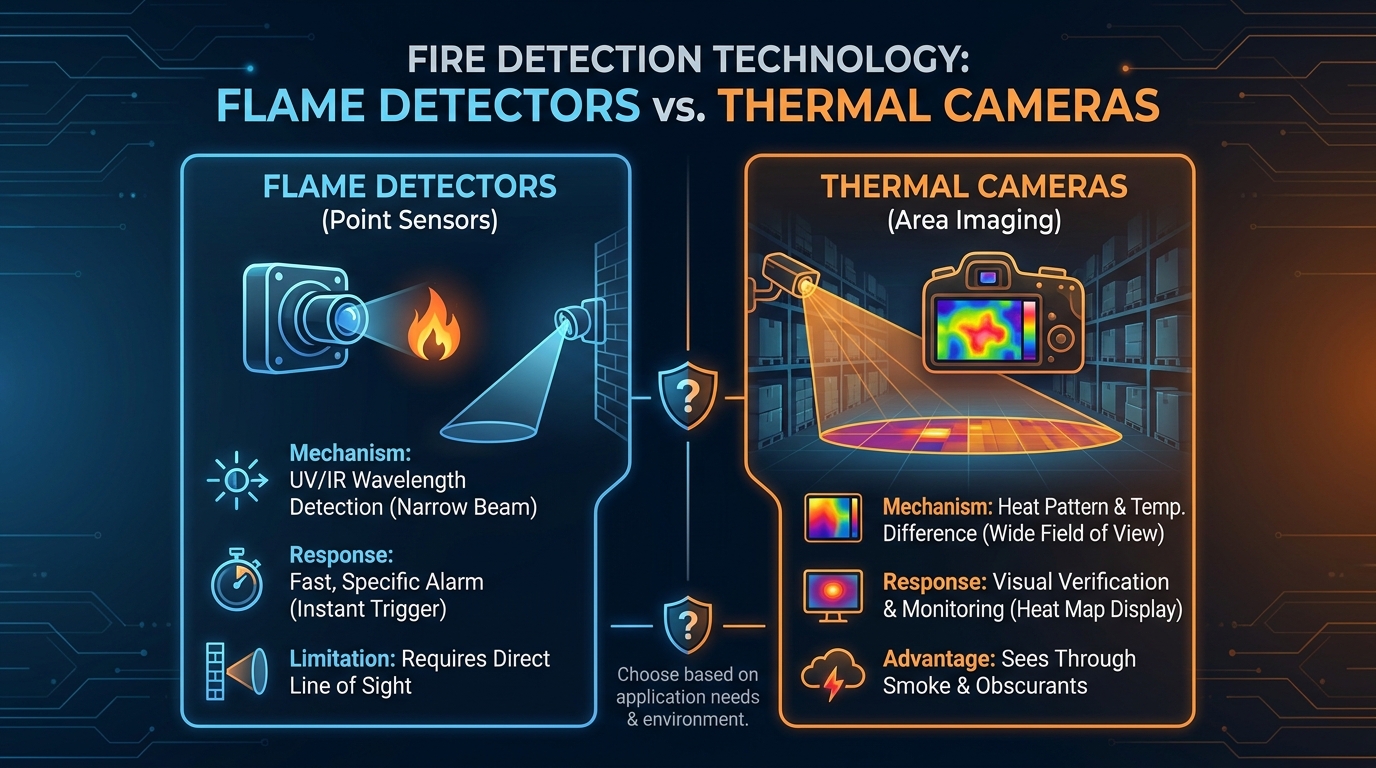
2026-05-11/Drew Hanover
Flame Detectors vs. Thermal Cameras for Early Fire Prevention
Flame detectors and thermal cameras are often compared because both use infrared energy to reduce fire risk.
They are not the same tool.
A flame detector recognizes the radiation pattern of an active flame. It is a fast detection device, often used in hazardous industrial areas where a flame must trigger an alarm or shutdown in seconds.
A thermal camera measures surface temperature. It can find abnormal heat on equipment, material, electrical assets, conveyors, bearings, battery racks, ducts, piles, and process areas before visible flame exists.
That difference matters for early fire prevention.
Flame detectors help you react quickly after ignition. Thermal cameras help you find the heat condition that may cause ignition in the first place.
The Short Answer
Use a flame detector when the critical event is an active flame and the response must be fast, certified, and tied into a safety system.
Use a thermal camera when the critical signal is heat build-up before smoke or flame appears.
In high-risk industrial facilities, the strongest design is often layered:
| Question | Flame detector | Thermal camera |
|---|---|---|
| What it detects | UV, IR, UV/IR, or multi-spectrum IR radiation from flame | Surface temperature and abnormal heat patterns |
| Earliest useful stage | After ignition, when flame radiation is present | Before ignition, when a surface or material gets hotter than normal |
| Typical response | Fire alarm, shutdown, suppression, operator response | Investigation, cooling, maintenance work order, shutdown, operator response |
| Best fit | Fuel handling, turbines, tank farms, chemical areas, hangars, paint booths, hazardous process areas | Bearings, motors, conveyors, panels, ducts, piles, hoppers, BESS, chargers, friction points, enclosed process equipment |
| Main advantage | Very fast detection of flame | Earlier warning of the conditions that can create fire |
| Main limitation | Usually does not warn before ignition | Needs line of sight to the surface being monitored |
| Certification focus | Fire performance, hazardous area, functional safety | Measurement accuracy, ingress protection, EMC, networking, cybersecurity, sometimes hazardous area |
If the goal is detecting flame, buy a flame detector.
If the goal is preventing fire, start with heat.
How Flame Detectors Work
Flame detectors look for radiation patterns that match combustion. Different models use different sensor strategies:
- UV detectors watch ultraviolet radiation from flame.
- IR detectors watch infrared energy from flame.
- UV/IR detectors combine ultraviolet and infrared signals to reject nuisance sources.
- IR3 or multispectrum IR detectors compare multiple infrared bands to improve range and false alarm rejection.
This is why flame detectors are common in special-hazard environments. A flame in a turbine enclosure, tank farm, fuel loading area, compressor station, paint booth, or chemical process area can escalate quickly. The system may need to alarm, trip equipment, close valves, or activate suppression.
Flame detector approvals are usually written in safety and hazardous-area language. Depending on the application, a project may require:
- FM, UL, CSA, ATEX, IECEx, UKCA, or other regional hazardous-area approvals.
- Fire performance standards such as FM 3260 or EN 54-10.
- Functional safety ratings such as SIL 2 or SIL 3 under IEC 61508.
- Marine or industry-specific approvals.
- Integration with a fire and gas panel, PLC, SIS, suppression system, or fire alarm control panel.
Manufacturer examples include Det-Tronics X3301, MSA General Monitors FL5000, Emerson Rosemount 975, and Spectrex SharpEye 40/40. Specific approvals depend on the exact part number, enclosure, output option, and region.
The common point is simple. A flame detector is built to see flame, and to see it fast.
It is not built to tell you that a bearing has been heating for three hours.
How Thermal Cameras Work
A thermal camera measures infrared radiation emitted by surfaces and turns it into temperature data.
That makes it useful before visible fire appears.
In industrial fire prevention, many events start as heat:
- A bearing runs hot from friction.
- A conveyor roller drags under load.
- A belt slips on a pulley.
- A motor overheats.
- A loose electrical connection creates resistance heat.
- Material begins to smolder in a duct, bin, hopper, or pile.
- A battery cell trends hotter than nearby cells.
- A charger, cabinet, or power supply moves outside its normal range.
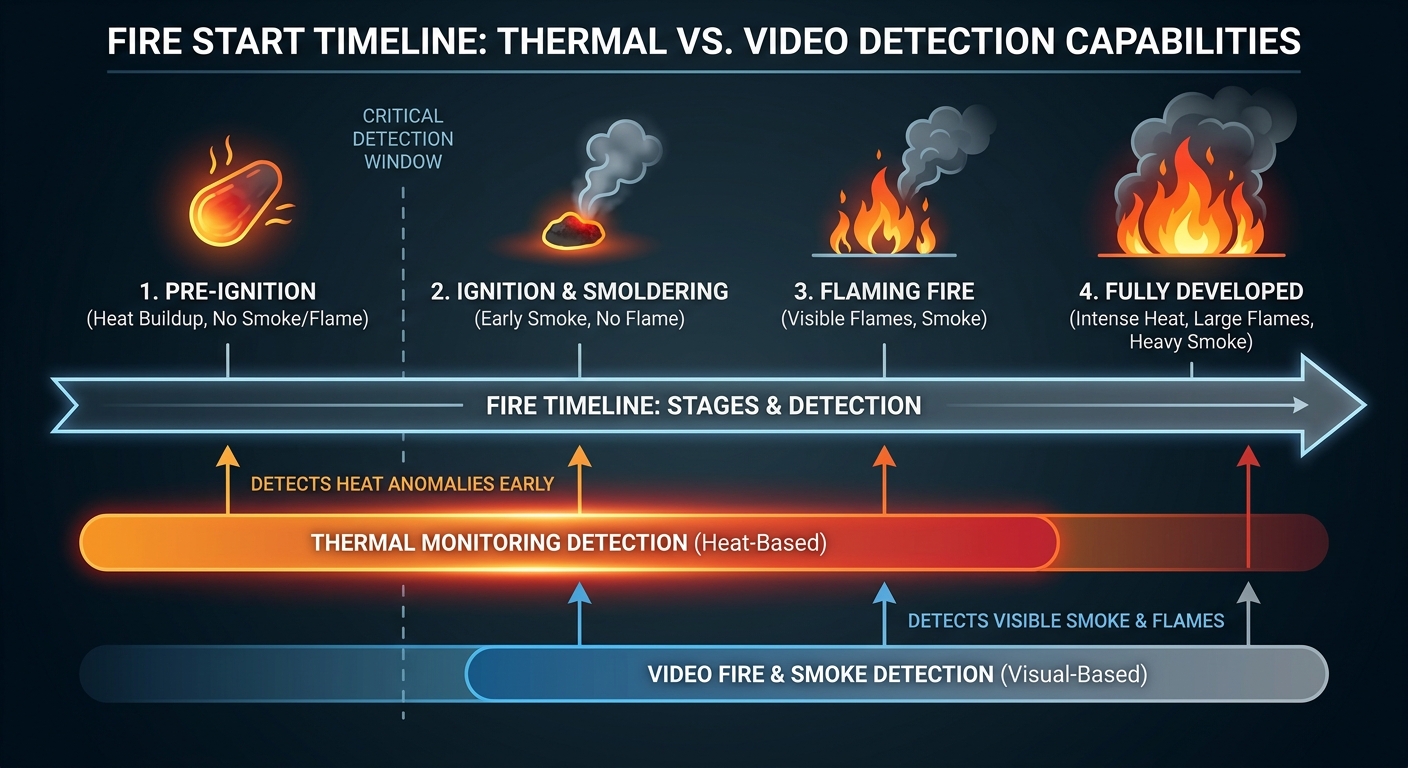
A flame detector becomes useful when combustion has produced flame radiation. A thermal camera becomes useful when an asset is hotter than it should be. That is often hours or days earlier in the timeline.
Industrial thermal cameras are typically specified in measurement and integration language rather than fire and gas language. Depending on the application, a project may care about:
- Calibrated radiometric accuracy and measurement range.
- Resolution, lens, field of view, frame rate, and thermal sensitivity (NETD).
- IP and impact ratings, EMC, shock, and vibration standards.
- Ethernet, PoE, digital outputs, and protocols such as Modbus TCP, MQTT, REST, or ONVIF.
- Analytics for hot-spot detection, zones, alarms, and event recording.
- Cybersecurity, user permissions, and audit trails.
Most fixed industrial thermal cameras are not a direct replacement for a code-required fire alarm system. They are a monitoring and prevention layer. They help the team see where heat is building and act earlier.
Pros and Cons
Flame Detectors
| Pros | Cons |
|---|---|
| Very fast detection once flame is present | Usually detects after ignition, not before |
| Strong fit for special-hazard and hazardous-area applications | Must be aimed at the likely flame area |
| Mature certification ecosystem for fire and gas safety | Requires careful layout, proof testing, and safety system integration |
| Can trigger shutdown, suppression, or alarms in seconds | Welding, hot work, sunlight, flare activity, and reflections must be considered |
| Long-range options exist for large hazard areas | Device and installed cost can be high |
Thermal Cameras
| Pros | Cons |
|---|---|
| Can detect abnormal heat before smoke or flame | Needs line of sight to the hot surface |
| Useful for fire prevention and condition-based monitoring | Reflections, emissivity, steam, dust, and viewing angle affect measurement quality |
| Covers zones and assets, not a single contact point | Requires good alarm logic to avoid nuisance alerts |
| Provides visual context and temperature history | Not automatically a replacement for a listed fire alarm system |
| Supports maintenance, safety, and operations from one event record | Most value comes from analytics and workflow, not only the camera |
Cost Estimates for 2026 Planning
| Category | Typical hardware range | Typical installed range |
|---|---|---|
| Certified flame detector | $2,000 to $10,000+ per detector | $5,000 to $20,000+ per detection point |
| Fixed thermal monitoring camera | $3,000 to $15,000+ per radiometric camera | $7,500 to $30,000+ per monitored zone |
Where Each Technology Fits
Choose a flame detector when:
- The hazard can produce open flame quickly.
- A confirmed flame should trigger an immediate alarm, shutdown, or suppression response.
- The area is hazardous, explosive, or governed by fire and gas safety requirements.
- You need model-specific approvals accepted by the authority, insurer, or safety team.
- The likely flame source is visible to the detector.
Choose a thermal camera when:
- Heat is the earliest useful warning sign.
- The facility has bearings, motors, panels, conveyors, ducts, piles, batteries, chargers, hoppers, or process equipment that can overheat.
- Operators need temperature trends, zones, and visual context.
- Maintenance and safety teams both benefit from the same alert.
- The goal is preventing ignition, not only detecting flame after ignition.
Use both when:
- The site has high fire load and high-value production assets.
- The cost of downtime or fire damage is high.
- There are fast flame hazards and slower heat-build-up hazards.
- The insurer, AHJ, or internal safety standard requires certified flame detection, but operations also wants earlier warning.
- You want layered protection from abnormal heat to visible fire.
How AVIAN T100 Fits the Thermal Camera Side
A thermal camera is only as useful as the workflow around it. A hot pixel on a screen is not a fire prevention strategy.
The AVIAN T100 thermal monitoring camera is built for the prevention side of this comparison. Each T100:
- Captures thermal and RGB data 24/7 on the same device.
- Detects anomalies on the edge so the camera, not a person, watches every frame.
- Filters nuisance conditions like forklifts, hot work, steam, and warm material that is normal for the process.
- Learns each asset's normal temperature pattern and flags drift as soon as it starts.
- Records thermal and visible event footage so operations can review what happened.
- Connects over Ethernet with PoE and exposes alarms to operators, maintenance, and control systems.
That is what turns a thermal camera from a measurement device into a fire prevention layer. The point is not that the T100 sees temperature. Many cameras see temperature. The point is that it is designed to catch the abnormal heat early, with enough context that the team trusts it and acts on it.
The T100 is not a replacement for a certified flame detector in an explosive atmosphere or fire and gas SIS. It is the heat-first layer that finds the bearing, motor, panel, duct, pile, or battery problem before there is anything for a flame detector to see.
The AVIAN View
AVIAN's position is not that thermal cameras replace flame detectors.
They do not.
Flame detectors are critical in the right special-hazard applications. If your risk analysis says an active flame must trip a safety function in seconds, use the certified detector and safety architecture designed for that job.
But many industrial fires do not start as a clean flame event in front of a detector.
They start as heat.
A bearing runs hot. A belt slips. Dust builds up. Material smolders. A panel connection loosens. A motor drifts outside its normal temperature. A battery cabinet develops an abnormal cell. Someone may have hours to act, but only if the facility is watching the right signal.
That is what AVIAN T100 is built for. AVIAN Vision covers a different layer by watching existing CCTV feeds for smoke and flame.
Together, the AVIAN approach is layered and practical:
- Use certified flame detectors where active flame detection is the safety requirement.
- Use AVIAN Vision where existing cameras can catch smoke or flame earlier than conventional detection alone.
- Use AVIAN T100 where abnormal heat is the first sign that something is going wrong.
The earlier you see the signal, the more options you have.
After flame appears, the response window is measured in seconds.
Before ignition, the response window may be minutes, hours, or days.
That is the difference between fire detection and fire prevention.
If you are comparing flame detectors, thermal cameras, or AI fire detection for an industrial facility, talk to the AVIAN team. We can help map which risks need certified flame detection, which assets need heat-first thermal monitoring, and where a layered approach makes the most sense.
Drew Hanover
CTO & Co-Founder
Get new AVIAN insights in your inbox
We'll send practical notes on industrial fire prevention, thermal monitoring, and customer learnings. No noise.