Back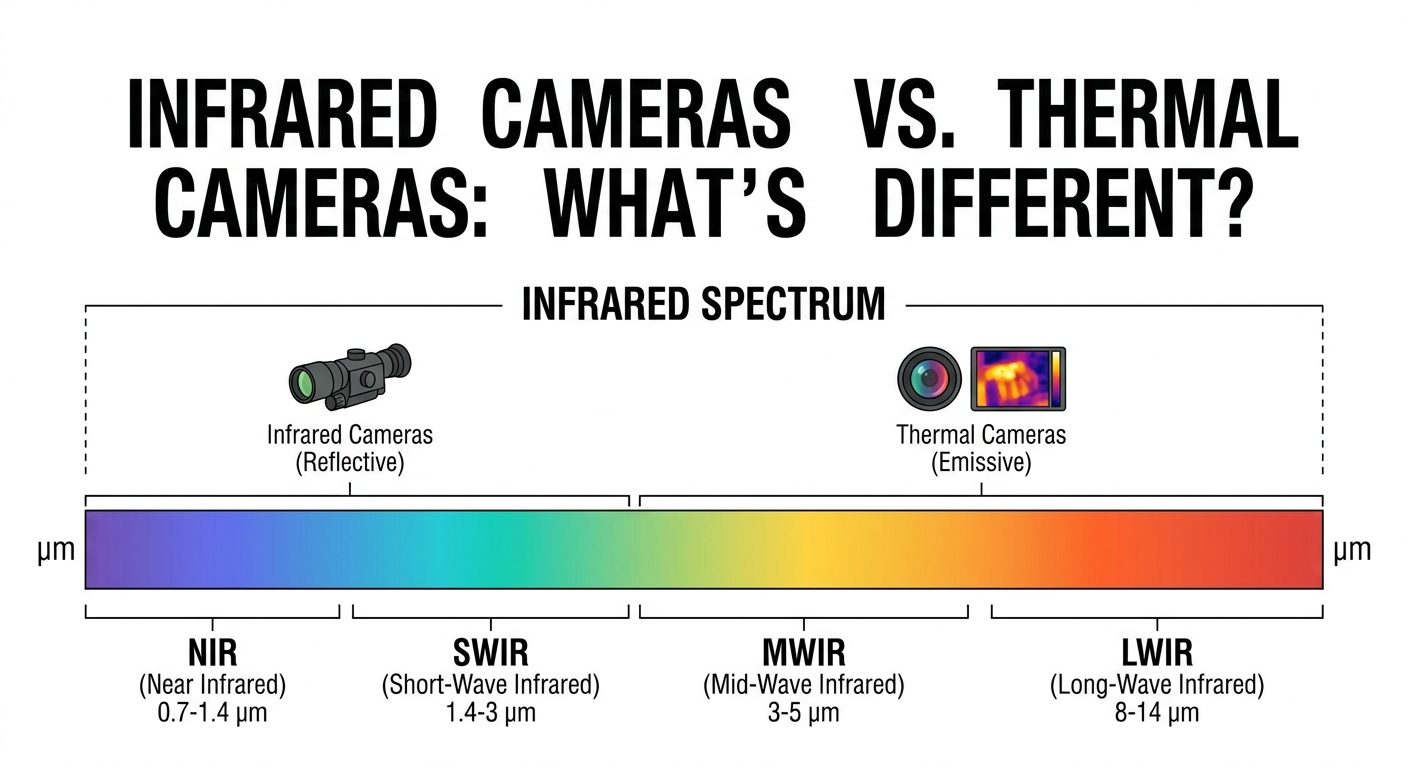
2026-05-08/Drew Hanover
Is There a Difference Between Infrared Cameras and Thermal Cameras?
Yes, there is a difference between infrared cameras and thermal cameras, but the terms overlap.
An infrared camera is any camera that detects light outside the visible spectrum in the infrared range. That can mean near-infrared, short-wave infrared, mid-wave infrared, or long-wave infrared.
A thermal camera is a specific type of infrared camera that detects heat emitted by objects. In practice, thermal cameras usually operate in the mid-wave infrared (MWIR) or long-wave infrared (LWIR) bands, because those wavelengths carry the heat signatures of objects at industrial and ambient temperatures.
So the short answer is:
- All thermal cameras are infrared cameras.
- Not all infrared cameras are thermal cameras.
The difference comes down to wavelength and whether the camera is seeing reflected light or emitted heat.
Start With the Electromagnetic Spectrum
Visible light is only a small part of the electromagnetic spectrum. Human eyes detect wavelengths from roughly 0.4 to 0.7 micrometers (µm), which correspond to violet through red light.
Infrared begins just beyond red light. It covers wavelengths longer than visible red light and shorter than microwaves. Depending on the classification system, infrared can extend from about 0.7 µm to 1000 µm.
For imaging and temperature measurement, the most common practical bands are:
| Band | Approximate wavelength | What it usually shows |
|---|---|---|
| Visible | 0.4 to 0.7 µm | Color and reflected visible light |
| NIR | 0.7 to 1.0 µm | Reflected near-infrared light |
| SWIR | 0.9 to 3.0 µm | Reflected infrared light, moisture, material differences |
| MWIR | 3.0 to 5.0 µm | Emitted heat from hotter objects, gases, flames, high-temperature equipment |
| LWIR | 8.0 to 14 or 15 µm | Emitted heat from people, buildings, machinery, bearings, motors, and ambient-temperature objects |
What "Infrared" Really Means
Infrared is a broad category. It does not automatically mean temperature.
Some infrared cameras see light that is reflected from a scene, much like a normal camera sees reflected visible light. Others see radiation emitted by objects because of their temperature.
That distinction matters.
If you use a night-vision security camera with infrared LEDs, the camera is often working in near-infrared. The LEDs illuminate the scene with light your eyes cannot see, and the camera records the reflected NIR light. The image may look black and white or green-tinted, but it is not a temperature map.
If you use a SWIR camera to inspect moisture in fruit, see through certain plastics, or inspect silicon wafers, the camera is detecting short-wave infrared light. It may reveal material properties that visible light misses, but it is still usually not measuring surface temperature the way a thermal camera does.
If you use a thermal camera to look at a motor, bearing, electrical connection, or person in total darkness, the camera does not need illumination. It is detecting energy emitted by the object itself.
That is the dividing line: reflected infrared versus emitted thermal radiation.
Near-Infrared (NIR): Just Beyond Visible Red
Near-infrared sits closest to visible light, usually around 0.7 to 1.0 µm.
NIR behaves more like visible light than heat. It reflects from surfaces, passes through some materials differently than visible light, and can be captured by sensors that are not far removed from ordinary camera technology.
Common NIR applications include:
- Night-vision cameras using infrared LEDs.
- Remote controls and optical communication.
- Machine vision inspection.
- Agriculture and vegetation analysis.
- Some medical and biometric imaging.
What NIR translates to in an image:
NIR usually shows reflectance, not temperature. Bright areas reflect more NIR light. Dark areas reflect less. If the scene has no NIR illumination or solar NIR available, the camera may not see much.
This is why a NIR security camera can see in the dark only when it has infrared illumination. It is not seeing heat in the way a thermal camera does.
Short-Wave Infrared (SWIR): Material Contrast and Reflected IR
Short-wave infrared usually covers roughly 0.9 to 3.0 µm.
SWIR is still closer to reflected-light imaging than thermal imaging for many practical uses. It can reveal information that visible and NIR cameras miss because materials absorb and reflect SWIR differently.
Common SWIR applications include:
- Moisture detection in food, wood, paper, and agricultural products.
- Semiconductor and silicon inspection.
- Sorting plastics, minerals, and other materials.
- Imaging through haze, smoke, or some packaging materials.
- Industrial machine vision where visible light does not show enough contrast.
What SWIR translates to in an image:
SWIR often shows material composition, moisture content, surface differences, and reflectance patterns. Water absorbs strongly in parts of the SWIR range, so wet areas can appear darker than dry areas. Some materials that look identical in visible light look very different in SWIR.
SWIR can detect very hot objects because hot objects emit shorter-wavelength infrared as temperature rises. But for normal room-temperature objects, SWIR is generally not the band used for passive thermal imaging.
Mid-Wave Infrared (MWIR): Thermal Imaging for Hotter Targets
Mid-wave infrared usually covers about 3.0 to 5.0 µm.
MWIR is where thermal imaging becomes central. Objects emit infrared radiation based on temperature, and hotter objects emit more energy at shorter infrared wavelengths. MWIR is useful when the target is significantly hotter than its surroundings or when specific gas absorption features matter.
Common MWIR applications include:
- High-temperature industrial processes.
- Furnace and kiln monitoring.
- Gas detection and optical gas imaging.
- Flame and combustion analysis.
- Defense, aerospace, and long-range surveillance.
- Engine, exhaust, and high-heat equipment monitoring.
What MWIR translates to in an image:
MWIR can show emitted heat, especially from hotter equipment and high-temperature processes. Many MWIR systems use cooled detectors because the sensor itself must be kept stable and sensitive enough to detect the target radiation. That makes MWIR systems powerful, but often more expensive and complex than uncooled LWIR cameras.
In industrial settings, MWIR is useful when the process temperature is high, when the scene includes flames or gases, or when the measurement needs a specific spectral response.
Long-Wave Infrared (LWIR): The Common Thermal Camera Band
Long-wave infrared usually covers about 8.0 to 14 or 15 µm.
LWIR is the band most people mean when they say "thermal camera." It is the practical thermal imaging band for people, buildings, electrical panels, bearings, motors, conveyors, and other objects near everyday or industrial operating temperatures.
Objects around room temperature emit strongly in the LWIR range. That is why LWIR cameras can see a person, a hot bearing, a warm motor, or a heat leak in total darkness without any external light source.
Common LWIR applications include:
- Industrial thermal monitoring.
- Electrical inspections.
- Mechanical inspections.
- Building diagnostics.
- Firefighting and search and rescue.
- Security and perimeter detection.
- Predictive maintenance and fire prevention.
What LWIR translates to in an image:
LWIR shows emitted heat from surfaces. A thermal image is a temperature map, not a color photograph. The camera assigns each pixel a value based on the infrared energy it receives, then displays that data using grayscale or false color.
For most industrial condition monitoring, LWIR is the practical choice because it can detect temperature differences on common equipment without needing external illumination.
Why Thermal Cameras Usually Do Not Use Visible Glass
The wavelength difference affects the hardware.
A visible-light camera can use ordinary glass lenses because visible light passes through glass well. Many thermal infrared wavelengths do not. Standard glass blocks much of the MWIR and LWIR radiation that thermal cameras need.
That is why thermal cameras use specialized lens materials such as germanium, silicon, zinc selenide, or chalcogenide glass, depending on the wavelength band and application.
This is also why a thermal camera looks different from a normal camera internally. It is not just a standard camera with different software. The optics, detector, calibration, and signal processing are built around the wavelength band the camera needs to measure.
Reflected Light vs. Emitted Heat
The easiest way to understand the difference is to ask one question:
Does the camera need light shining on the object?
If the answer is yes, the camera is probably working with reflected light. That includes visible cameras, many NIR cameras, and many SWIR systems.
If the answer is no, and the camera can see the object because the object itself is radiating energy based on temperature, the camera is working thermally. That is the world of MWIR and LWIR thermal imaging.
There are edge cases. Very hot objects emit enough energy at shorter wavelengths to become visible or detectable in SWIR. Reflections can also affect thermal measurements, especially on shiny metal surfaces. But for most practical use, the reflected-versus-emitted distinction is the cleanest way to separate infrared imaging from thermal imaging.
Where Thermal Cameras Fit in Industrial Monitoring
Industrial thermal cameras are usually designed to detect temperature differences across equipment and process areas.
That makes them useful for:
- Bearings that heat up before failure.
- Motors running hotter than normal.
- Electrical connections with high resistance.
- Conveyors, rollers, and belts generating friction heat.
- Dust collection systems with smoldering material or blocked flow.
- Battery areas where cells or packs begin to heat abnormally.
- Stockpiles, hoppers, and storage zones where hidden heating can become a fire risk.
The camera is not identifying color, texture, or material composition the way visible, NIR, or SWIR cameras might. It is measuring emitted infrared energy and translating that into temperature patterns.
That is why thermal imaging is so useful for condition monitoring and infrared monitoring. Heat is often the first visible signal that a machine, electrical component, or stored material is moving outside its normal state.
Common Misunderstandings
"Infrared camera" and "thermal camera" always mean the same thing.
They do not. A thermal camera is an infrared camera, but an infrared camera may be NIR, SWIR, MWIR, or LWIR. Only some of those are thermal in the practical sense.
Night vision is the same as thermal imaging.
Usually not. Many night-vision cameras use NIR illumination and reflected light. A thermal camera can see in darkness without illumination because it detects emitted heat.
Thermal cameras see through walls.
They do not. Thermal cameras measure infrared energy from surfaces in their line of sight. If heat inside a wall changes the surface temperature, the camera may show that surface difference. It is not seeing through the wall.
All infrared radiation is heat.
Infrared radiation is electromagnetic radiation. It can carry heat energy when absorbed, and warm objects emit infrared radiation, but not every infrared imaging application is a temperature measurement.
The Bottom Line
There is a difference between infrared cameras and thermal cameras.
Infrared cameras are the broad category. They detect infrared wavelengths beyond visible red light. That category includes NIR, SWIR, MWIR, and LWIR systems.
Thermal cameras are a narrower category. They detect emitted heat, usually in the MWIR or LWIR bands. For most industrial and ambient-temperature applications, LWIR is the common thermal imaging band.
If you want material contrast, night vision with illumination, or moisture detection, you may be talking about NIR or SWIR infrared imaging.
If you want to see heat from motors, bearings, electrical panels, conveyors, people, buildings, or fire-risk areas, you are talking about thermal imaging.
Drew Hanover
CTO & Co-Founder
Get new AVIAN insights in your inbox
We'll send practical notes on industrial fire prevention, thermal monitoring, and customer learnings. No noise.