Back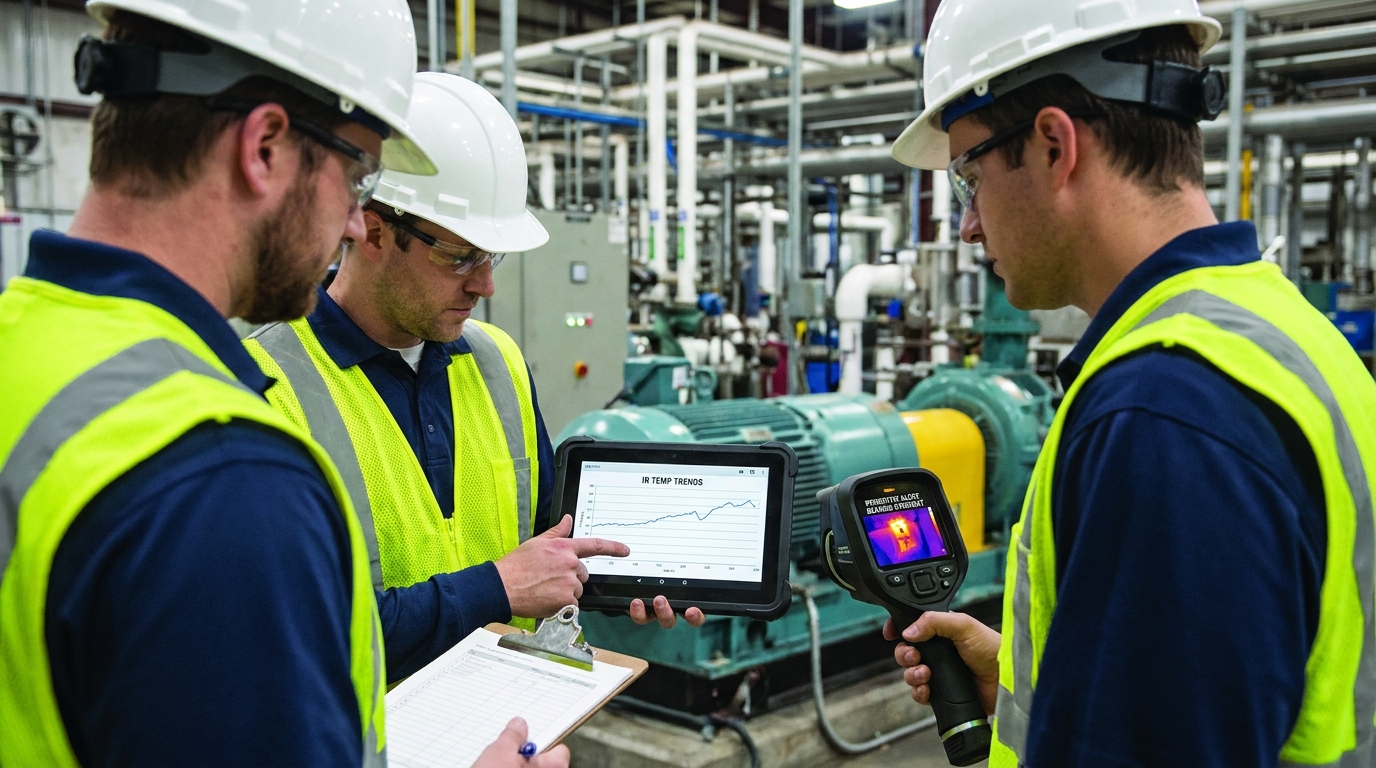
2026-05-03/Drew Hanover
Condition-Based Maintenance vs Predictive Maintenance: What's the Difference?
Condition-based maintenance and predictive maintenance are closely related, but they are not the same thing.
Condition-based maintenance means you maintain equipment when measured conditions show that action is needed. A temperature, vibration, pressure, oil, or electrical reading moves outside the normal range, and the team responds.
Predictive maintenance goes one step further. It uses condition data, trends, analytics, and sometimes machine learning to estimate what is likely to happen next. The goal is not only to see that a machine is abnormal today. The goal is to predict when it may fail, how urgent the issue is, and when maintenance should be scheduled.
In simple terms:
- Condition-based maintenance answers: "Does this asset need attention now?"
- Predictive maintenance answers: "When is this asset likely to need attention?"
The two strategies work best together. Condition data is the foundation. Predictive maintenance is what you build on top of that data when you have enough history, context, and analytics to forecast deterioration.
The Quick Comparison
| Question | Condition-based maintenance | Predictive maintenance |
|---|---|---|
| Main idea | Maintain based on actual condition | Predict future failure or degradation |
| Trigger | A measured value crosses a threshold or baseline | A trend suggests a future failure window |
| Data needed | Current and recent equipment condition | Historical trends, operating context, and models |
| Typical output | Inspect, repair, slow down, or stop the asset | Schedule work before the predicted failure point |
| Best for | Catching abnormal conditions early | Planning maintenance around expected deterioration |
| Risk if done poorly | Too many alerts or missed thresholds | False confidence from weak models or poor data |
That distinction matters because many teams use the terms interchangeably. They are connected, but they describe different levels of maintenance maturity.
What Condition-Based Maintenance Means
Condition-based maintenance (CBM) is a maintenance strategy where work is triggered by the actual state of the asset.
The asset is monitored. The team defines what normal looks like. When the measured condition moves outside that normal range, maintenance acts.
For example:
- A bearing normally runs at 48°C but starts trending at 62°C under the same load.
- A motor starts drawing more current than similar motors on the same line.
- A vibration sensor detects a bearing defect frequency.
- An oil sample shows contamination or wear particles.
- A hydraulic system shows abnormal pressure or temperature.
- An electrical connection is running hotter than the other phases in the same cabinet.
In each case, the maintenance decision is based on condition, not calendar.
That is the key difference from preventive maintenance. Preventive maintenance says, "Replace this part every six months." Condition-based maintenance says, "Replace this part when the data shows it is deteriorating."
CBM is especially useful when assets do not age evenly. In industrial plants, that is almost always the case. Load, dust, moisture, ambient temperature, operating hours, product mix, and maintenance history all change how equipment wears.
What Predictive Maintenance Means
Predictive maintenance uses condition data to forecast future maintenance needs.
It does not only identify that something is abnormal. It tries to estimate where the asset is on the failure curve.
For example:
- A bearing temperature trend suggests the bearing may reach an unsafe level within two weeks.
- Vibration data shows a defect pattern that is increasing at a predictable rate.
- Motor current and temperature indicate load-related degradation that is getting worse across shifts.
- Thermal data shows a conveyor roller drifting slowly above its peers over several days.
- Historical failure data suggests a specific component has entered a high-risk period.
Predictive maintenance depends on more than a single reading. It needs trend data, context, and a way to interpret the signal.
That interpretation can be simple or advanced. Sometimes it is a technician looking at a trendline and making a judgment. Sometimes it is software using baseline models, anomaly detection, or remaining-useful-life estimates.
The point is the same: predictive maintenance turns condition data into a maintenance forecast.
Condition Monitoring, CBM, and Predictive Maintenance
Three terms often get mixed together:
Condition monitoring is the act of measuring equipment condition. The system collects temperature, vibration, oil, current, pressure, acoustic, or other data.
Condition-based maintenance is the maintenance strategy that uses that data to decide when to act.
Predictive maintenance is the planning strategy that uses that data over time to forecast failure risk and schedule work before failure.
The sequence looks like this:
- Monitor the asset.
- Detect abnormal condition.
- Decide whether maintenance is needed.
- Use trends to predict what happens next.
- Schedule the work before the failure becomes forced downtime.
You cannot have useful predictive maintenance without condition monitoring underneath it. And you cannot get much value from condition monitoring unless the maintenance team has a clear way to act on the data.
Where Infrared Fits Into Predictive Maintenance
Infrared for predictive maintenance is valuable because many industrial failure modes show up as heat before they show up as failure.
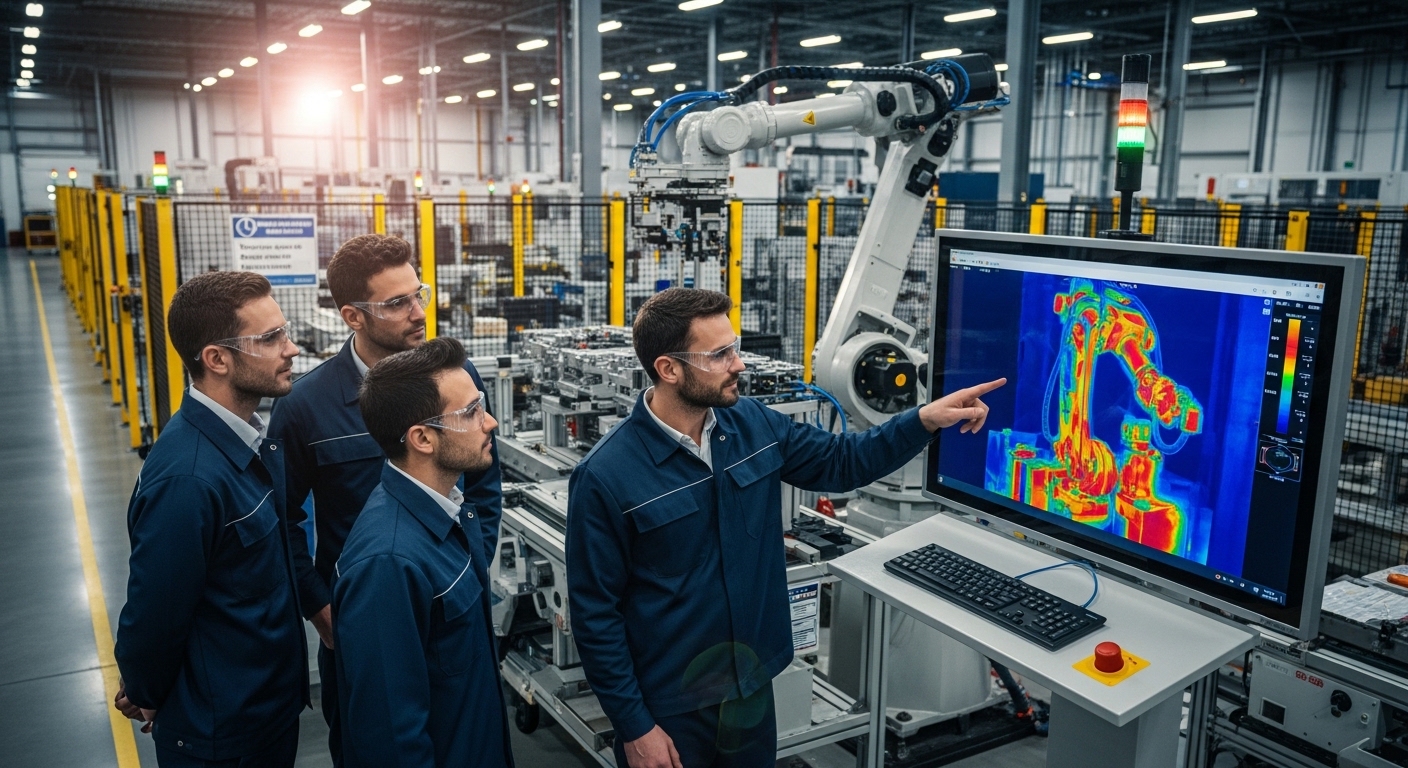
A thermal camera measures infrared radiation emitted by surfaces and converts it into temperature data. In industrial maintenance, that temperature data can reveal friction, overload, resistance, blocked flow, smoldering material, or abnormal process heat.
Common examples include:
- Bearings heating from friction before they seize.
- Motors running hotter under abnormal load.
- Electrical lugs heating from loose or corroded connections.
- Belts slipping and creating friction heat.
- Conveyor rollers dragging under load.
- Hydraulic systems heating from restriction or leakage.
- Dust collection lines showing heat from blocked flow or smoldering material.
- Battery cells running hotter than neighboring cells.
This makes infrared useful for both condition-based maintenance and predictive maintenance.
In a CBM program, infrared can trigger an action when a component is hotter than normal.
In a predictive maintenance program, infrared trend data can show how fast the component is deteriorating, whether the issue is stable or accelerating, and when the team should intervene.
Why Infrared Data Is Different From Vibration Data
Vibration is one of the classic predictive maintenance signals. It is excellent for rotating machinery diagnostics. If a pump, fan, motor, or compressor has a bearing defect, imbalance, misalignment, or looseness, vibration analysis can provide detailed information.
Infrared is broader.
It does not require physical contact with the asset. It can monitor many visible components at once. It can detect heat from rotating equipment, non-rotating equipment, electrical systems, conveyors, panels, ductwork, and material storage areas.
That breadth matters in industrial environments where the risk is not limited to rotating machinery.
A vibration sensor can tell you a motor bearing is developing a fault. It cannot tell you that a nearby electrical lug is overheating, a belt is slipping, or material is smoldering in a duct. Infrared can see those heat patterns if the camera has line of sight.
That does not make infrared "better" than vibration in every case. It makes it different. Vibration is strong for mechanical diagnosis. Infrared is strong for heat-related condition changes across mixed assets.
We covered this comparison in more detail in Thermal Imaging vs. Vibration Sensors.
Condition-Based Maintenance Example
Imagine a conveyor drive motor in a processing plant.
During normal operation, the motor frame runs between 55°C and 60°C. A fixed thermal camera monitors the motor continuously. One week, the motor begins running at 68°C under similar load and ambient conditions.
A condition-based maintenance program responds to that change.
The system flags the motor as abnormal. Maintenance checks the motor, coupling, belt tension, ventilation, and load. The team may clean the cooling fins, correct alignment, reduce load, or schedule a replacement.
The decision is based on measured condition. The motor is not serviced because the calendar says so. It is serviced because the data shows a meaningful change.
That is condition-based maintenance.
Predictive Maintenance Example
Now imagine the same motor over a longer period.
Instead of a sudden jump from 58°C to 68°C, the motor temperature rises slowly over six weeks. It starts at 58°C, then 60°C, then 62°C, then 64°C. The load is similar. Ambient temperature is similar. Similar motors on the same line are stable.
That trend tells a different story.
A predictive maintenance program looks at the rate of change. It may estimate when the motor will reach a warning threshold, when the next planned shutdown occurs, and whether the repair can wait.
The output is not only "this motor is hot." It becomes "this motor is degrading, the trend is accelerating, and the best maintenance window is next Tuesday's planned stop."
That is predictive maintenance.
Which Strategy Is Better?
The better question is not which strategy is better. The better question is which decision you are trying to make.
Use condition-based maintenance when you need to know whether an asset is currently outside normal operating condition.
Use predictive maintenance when you need to plan around where the asset is likely headed.
Most industrial teams need both.
Condition-based maintenance is the first step because it gives the team a practical rule for action. Predictive maintenance becomes more useful as the dataset grows and the team learns how each asset behaves under real operating conditions.
The mistake is buying "predictive maintenance" software before the monitoring program is mature enough to feed it reliable data.
Predictions are only as good as the measurements, baselines, and context underneath them.
What Makes Infrared Useful for Both
Infrared works well across both strategies because heat is a common signal.
Friction creates heat. Electrical resistance creates heat. Overload creates heat. Restricted flow creates heat. Smoldering material creates heat. Battery faults create heat.
A continuous thermal monitoring system can turn those heat patterns into a maintenance signal:
- For CBM: Is this component hotter than its normal baseline?
- For predictive maintenance: Is the temperature trend stable, worsening, or accelerating?
The same sensor can support both questions.
This is especially useful in facilities with many different asset types in the same area. A sawmill planer room, recycling line, battery charging area, or bulk handling facility may have motors, bearings, conveyors, panels, dust, and material flow all in one zone.
Infrared monitoring gives that zone a shared condition signal: temperature.
Common Mistakes
The first mistake is treating condition-based maintenance and predictive maintenance as competing strategies. They are stages of the same maturity curve.
The second mistake is assuming predictive maintenance always means advanced AI. Sometimes the most useful prediction is a clear trendline that shows a bearing is getting hotter every week.
The third mistake is using fixed thresholds for everything. A bearing that normally runs at 35°C and rises to 50°C may deserve attention, even if 50°C is below a generic alarm level. Baselines matter.
The fourth mistake is ignoring operating context. Temperature changes with load, ambient conditions, product mix, and shift. A good program compares assets against their own normal behavior, not just a universal number.
The fifth mistake is collecting data without a maintenance workflow. If nobody owns the alert, schedules the work, or closes the loop, the monitoring program becomes a dashboard instead of a maintenance system.
The Bottom Line
Condition based maintenance vs predictive maintenance is not an either-or choice.
Condition-based maintenance uses real equipment condition to decide when action is needed. Predictive maintenance uses condition trends to estimate what is likely to happen next and when maintenance should be scheduled.
Infrared supports both because heat is one of the earliest and broadest signals of equipment stress. A thermal camera can detect abnormal temperature on bearings, motors, panels, conveyors, hydraulics, batteries, and fire-risk areas before those issues become forced downtime or safety events.
Start with reliable condition monitoring. Build strong baselines. Make sure alerts create action. Then use the trend data to predict what comes next.
That is how condition-based maintenance becomes predictive maintenance in practice.
If your maintenance and safety teams are trying to use the same heat signal, read how AVIAN connects fire prevention and predictive maintenance.
If you want to understand how infrared predictive maintenance fits into your operation, reach out to the AVIAN team. We can review your critical assets and identify where thermal monitoring gives you the clearest maintenance signal.
Drew Hanover
CTO & Co-Founder
Get new AVIAN insights in your inbox
We'll send practical notes on industrial fire prevention, thermal monitoring, and customer learnings. No noise.