Back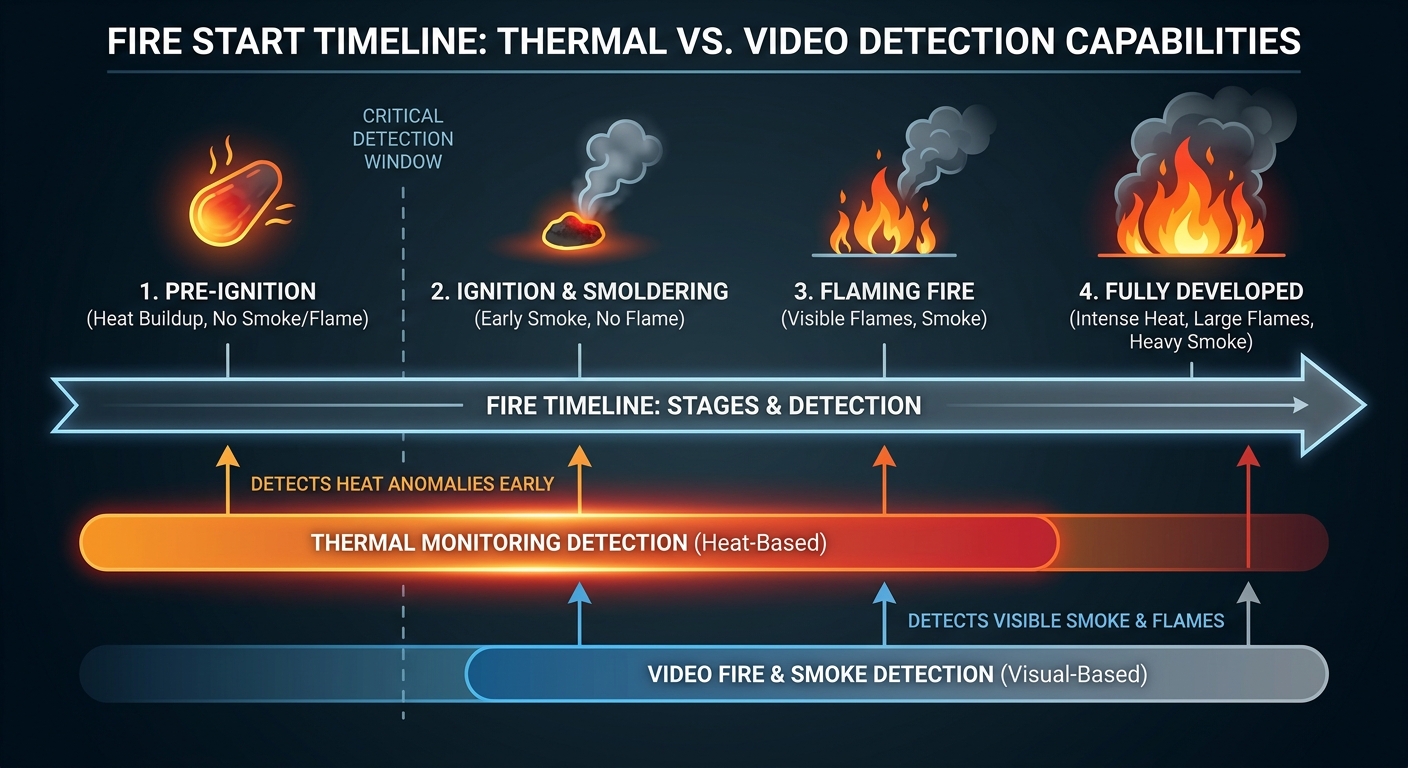
2026-05-18/Drew Hanover
Fire Rover vs. AVIAN: Suppressing Fires vs. Preventing Them Earlier
Fire Rover is a serious fire protection company.
That matters up front. This is not a comparison between AVIAN and a weak product. Fire Rover has built a strong position in waste, recycling, metal processing, wood processing, marine, and other high-risk environments where fires are hard to control once they start.
Their system combines thermal cameras, flame detection, smoke analytics, human verification, and remote-operated suppression. In the right facility, that is a valuable layer.
But it is not the same thing as AVIAN.
The practical difference is where each system is designed to act in the fire timeline.
Fire Rover is strongest when the site needs verified fire detection and targeted suppression. AVIAN is built to find abnormal heat earlier, before smoke, flame, or a suppression-level event exists.
The Short Answer
Fire Rover helps facilities detect and suppress fire events quickly.
AVIAN helps facilities catch the heat conditions that may create those fire events in the first place.
| Question | Fire Rover | AVIAN |
|---|---|---|
| Primary role | Verified detection plus remote suppression | Heat-first thermal monitoring and prevention |
| Earliest useful signal | Thermal anomaly, smoke, flame, or early combustion event | Abnormal temperature behavior before smoke or flame |
| Typical response | Monitoring center verification, suppression, site alerts, possible 911 escalation | Operator alert, investigation, cooling, maintenance, shutdown, PLC action |
| Main advantage | Can put water or agent on a confirmed fire fast | Can alert before there is a fire to suppress |
If the problem is "we need someone to remotely knock down a fire once it starts," Fire Rover may be the right tool.
If the problem is "we want to know what is getting hot before smoke appears," AVIAN is the better fit.
Fire Rover Is Built Around Detection to Suppression
Fire Rover describes its early detection system as a combination of infrared cameras, thermal sensors, smoke analytics, flame analytics, and human verification. Its waste and recycling page says the system detects incipient fires using thermal imaging, flame, and smoke analytics, then confirms threats through 24/7 live human monitoring before initiating real-time suppression.
That model is designed around a clear operating sequence:
- Cameras or analytics identify a possible event.
- The event is sent to a monitoring center.
- A trained agent verifies the threat.
- If needed, the agent operates a monitor or suppression system.
- Site personnel and emergency responders are notified according to protocol.
That is useful because industrial fire response is slow when it depends only on a municipal fire department.
In a 2026 Fire & Safety Journal Americas interview, Ryan Fogelman of Fire Rover said municipal response to waste and recycling facilities often ranges from 8 to 12 minutes, and that the first 6 to 10 minutes can decide whether an incident stays minor or becomes catastrophic. Fire Rover's argument is that thermal cameras, analytics, human operators, and targeted suppression can close that gap.
It is a good argument.
It is also still a response argument.
Why AVIAN Starts Earlier
Many industrial fires do not begin as a visible fire.
They begin as heat:
- A bearing starts running hotter than its normal baseline.
- A conveyor roller drags under load.
- A belt rubs a skirt board.
- A motor overheats.
- A loose electrical connection builds resistance heat.
- Dust or material smolders in a duct, hopper, cyclone, pile, or enclosure.
- A charger or battery area develops an abnormal hot spot.
At that stage, there may be no smoke. No flame. No fire event on video. Nothing for a human operator to suppress.
But there is a temperature problem.
That is where AVIAN is designed to operate. The AVIAN T100 thermal monitoring system watches assets and risk zones continuously, learns normal thermal behavior, filters nuisance heat sources, and alerts the people who can act.
The alert can happen while the response is still boring:
- Inspect the bearing.
- Clear material from the duct.
- Stop the conveyor.
- Cool the hot spot.
- Tighten the connection.
- Move the load.
- Schedule the repair.
That is the point. The best fire response is the one that never becomes a fire response.
Smoke and Flame Are Already Late Signals
Fire Rover's own materials recognize the fire timeline. Their early detection page lists a pre-incipient stage where invisible heat buildup begins before smoke or flame, followed by incipient, smoldering, flame, fire, and major fire stages.
That timeline is exactly why thermal monitoring matters.
Once smoke is visible, damage may already be happening. Once flame is visible, the response window is measured in seconds. Once suppression is required, the facility is already managing an emergency.
AVIAN's goal is to move the alert earlier than that.
We do not want the first meaningful signal to be smoke at the pile, flame on the belt, or an operator deciding whether to open a monitor. We want the first signal to be abnormal heat while the team can still intervene with maintenance, cleaning, isolation, cooling, or a controlled shutdown.
That is a different product philosophy.
Fire Rover asks, "Is this a real fire event that needs a verified response?"
AVIAN asks, "What is getting hotter than it should before a fire event exists?"
Human Verification Adds Judgment and Delay
Human verification can be valuable. It helps reduce false alarms and makes sense before activating suppression.
But human verification also means the system is designed to pause for a decision at the moment the event matters most.
That is not a criticism. If a remote operator is about to discharge water or agent into a production area, verification is responsible. You do not want a false alarm soaking equipment, product, conveyors, sorters, panels, or floor staff.
The tradeoff is that the workflow fits suppression more than prevention.
AVIAN does not need a remote dispatcher to decide whether a bearing trend is worth putting in front of maintenance. The system can notify the right plant team immediately with the thermal image, visible context, temperature history, and location. For critical events, AVIAN can also integrate with a PLC or control system so the site can stop a conveyor, trigger an interlock, or escalate the alarm without waiting for someone at a monitoring center to choose a response.
In other words:
Fire Rover uses human verification because suppression is a high-consequence action.
AVIAN alerts earlier so the first action does not have to be suppression.
The Damage Question
There is another practical difference: what has already happened by the time the system acts?
If a facility waits for smoke, flame, or active suppression, damage may already be underway:
- Material may be burning or smoldering.
- Belting may be scorched.
- Dust may be igniting inside a duct.
- A pile may be generating smoke or gas.
- A battery may already be in thermal runaway.
- Equipment may need inspection, cleanup, or replacement before restart.
Fire Rover can help keep that damage from becoming catastrophic. That is valuable.
AVIAN is aimed at the earlier layer: catch the heat condition before the facility is counting burned material, cleanup time, water discharge, smoke contamination, or emergency response.
For many operators, that is the real goal. Not a faster fire. No fire.
Where Fire Rover Makes Sense
Fire Rover can be a strong fit when a facility needs remote suppression as part of the protection strategy.
That often means:
- Waste and recycling floors.
- Outdoor piles and open yards.
- Transfer stations.
- Scrap and metal processing.
- Large hazard areas where people may not be nearby.
- Sites where a remote operator needs to aim water or agent at a specific burning area.
- Locations where sprinkler coverage is difficult, too broad, or too damaging.
The Fire & Safety Journal Americas profile on Fire Rover reported examples where the system identified hot spots, used targeted water discharge, and helped avoid larger losses in recycling and waste facilities. It also reported Fire Rover statistics from 2024 across hundreds of customer locations: thousands of verified hot spots, hundreds of fires extinguished with its monitors, and additional calls to public firefighters for backup.
That is not a camera-only story. It is a fire protection and suppression story.
If that is what your facility needs, take it seriously.
Where AVIAN Wins
AVIAN is the stronger choice when the goal is continuous heat-first monitoring across the assets and material flows that start fires.
That includes:
- Conveyor bearings, pulleys, rollers, and belt edges.
- Motors, gearboxes, drives, and hydraulic units.
- Electrical panels, MCCs, bus ducts, and chargers.
- Dust collection lines, cyclones, hoppers, and silos.
- Biomass, bark, pellet, grain, coal, and waste piles.
- Battery areas, charging zones, and power electronics.
- Process zones where abnormal heat is the first sign of failure.
The difference is the alert logic.
AVIAN is not only looking for a fire. It is looking for a change from normal. A bearing does not need to be at flame temperature to matter. A belt edge does not need to smoke before it needs attention. A pile does not need to glow before the surface temperature pattern deserves inspection.
That is why AVIAN is useful to operations, maintenance, and safety at the same time.
The same alert that prevents a fire can also prevent downtime.
Use Both When the Risk Justifies It
This does not have to be an either-or decision.
Some facilities may need both:
- Fire Rover or another suppression layer for high-risk open areas where active fire response must be immediate.
- AVIAN T100 cameras for the assets and material zones where abnormal heat gives the earliest warning.
- AVIAN Vision for existing CCTV feeds where smoke and flame detection adds broad coverage.
- Sprinklers, alarms, aspirating systems, and certified detection where code, insurer, or AHJ requirements demand them.
Layered protection works when each layer has a clear job.
The mistake is asking a suppression system to be the whole prevention plan, or asking a prevention system to replace the layers that control a fire after ignition.
The Bottom Line
Fire Rover is built to detect fire events, verify them, and suppress them quickly.
AVIAN is built to catch abnormal heat before smoke, flame, or suppression is needed.
That distinction matters. If you are already looking at smoke or flame for more than a minute before acting, the facility is late. If the first response is water or agent, something has already escalated.
Thermal monitoring gives you a better first move.
See the heat. Understand the context. Alert the right team. Fix the condition before it becomes a fire.
That is the AVIAN view of prevention.
If you are comparing Fire Rover, video fire detection, remote suppression, or thermal monitoring for an industrial facility, talk to the AVIAN team. We can help map which risks need suppression and which assets need heat-first monitoring before smoke appears.
Drew Hanover
CTO & Co-Founder
Get new AVIAN insights in your inbox
We'll send practical notes on industrial fire prevention, thermal monitoring, and customer learnings. No noise.