Back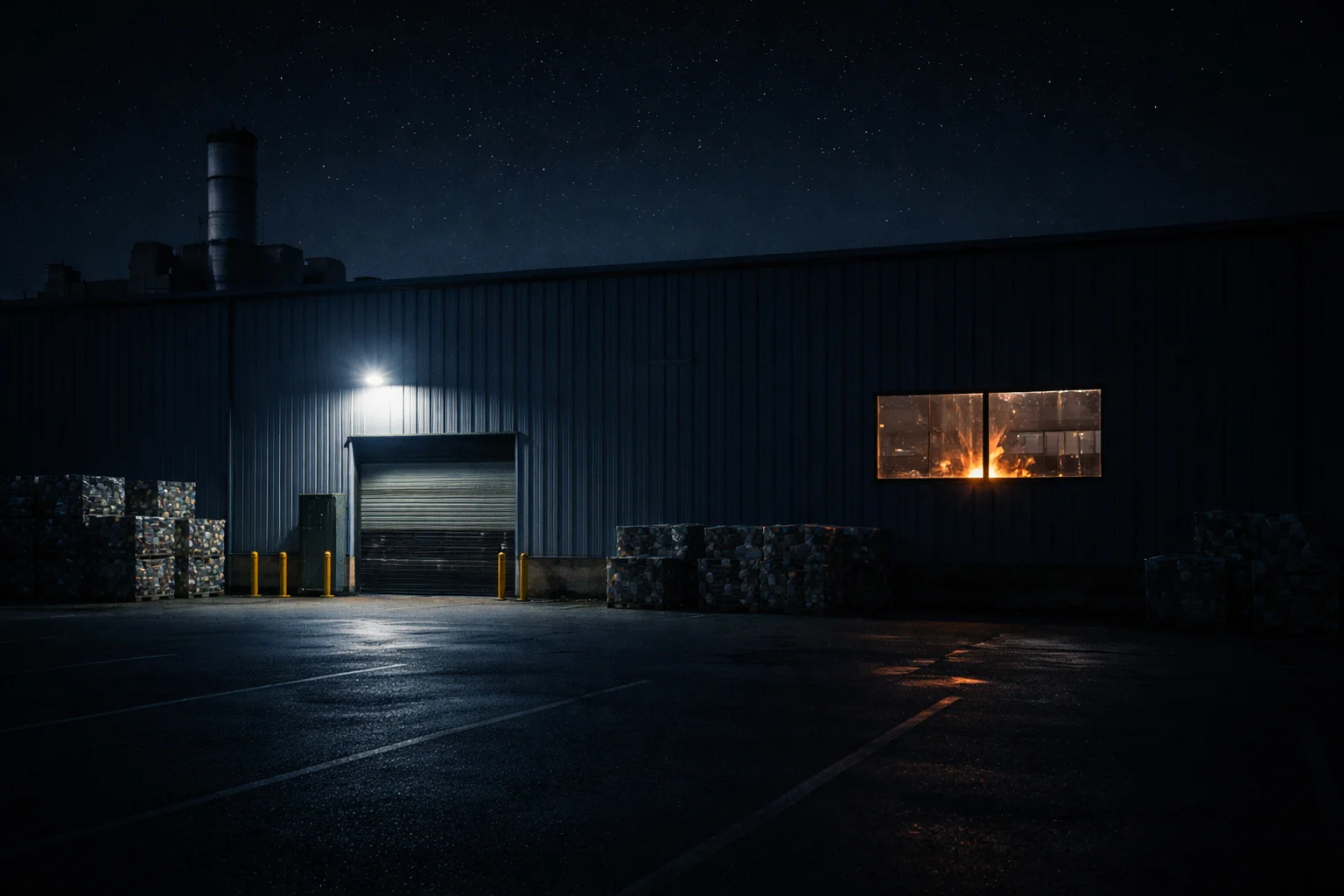
2026-03-01/Dom knull
Why Recycling Facility Fires Happen at Night — And What to Do About It
The most dangerous hours at your facility are the ones where nobody is watching.
Talk to any recycling or waste processing operator who's dealt with a serious fire, and chances are it happened at night. Or on a weekend. Or during a holiday shutdown. The pattern is so consistent it's almost predictable — except that most facilities aren't set up to do anything about it.
The reason is straightforward. Fires don't care about your staffing schedule. The physics of thermal runaway, spontaneous combustion, and equipment overheating operate on their own timeline. A battery that gets crushed at 4PM can ignite at midnight. A waste pile that absorbs heat all day can reach ignition temperature after sunset. A conveyor bearing that's been running hot all shift can seize and spark two hours after the crew goes home.
The fire starts when conditions are right. Not when it's convenient.
The After-Hours Gap
During a normal operating shift, you have eyes everywhere. Operators on the floor. Supervisors doing walkthroughs. Equipment operators who notice when something smells off. There's a density of human awareness that acts as an informal detection system.
After hours, that disappears.
A skeleton night crew — if you have one — is covering a much larger area with far fewer people. They're running operations, not patrolling for hotspots. The areas between conveyors, inside bale storage, across tipping floors, and in outdoor yards aren't getting the same attention they get during peak staffing.
And here's the reality that makes it worse: the material doesn't stop being dangerous just because the shift ended.
Waste piles continue decomposing. Organic material generates heat through biological processes that don't pause for the weekend. Damaged lithium-ion batteries buried in processed material can enter thermal runaway hours or days after initial damage. Bales stacked for storage can contain compressed batteries that slowly heat until they ignite.
The risk is the same — or higher — at night. The detection capability drops to nearly zero.
What a Fire at 2AM Actually Looks Like
Here's a scenario that plays out more often than anyone in the industry likes to admit.
It's Saturday night. The last shift clocked out at 6PM. The facility is unattended. Maybe there's a security guard doing perimeter checks, but they're not trained on fire detection and they're not inspecting waste piles with a thermal camera.
At 10PM, a lithium-ion cell buried in a bale of mixed recyclables — crushed during Friday afternoon's processing — enters thermal runaway. The cell heats to over 150°C. Surrounding cardboard begins to smolder.
By midnight, the smoldering has spread to adjacent bales. There's no visible flame yet — just heat and a small amount of smoke that hasn't reached the ceiling-mounted detector 30 feet above.
At 2AM, the fire breaks through. Flames are now visible. The smoke detector finally activates. Sprinklers engage. But the fire has had four hours of head start in a facility full of combustible material.
The fire department arrives at 2:30AM. By then, the fire has spread beyond the bale storage area. The suppression system is overwhelmed.
By morning, you're looking at a partial or total facility loss. Millions of dollars in damage. Weeks or months of downtime. An insurance claim that may not cover the full cost — if you're still insured at all.
All because the fire started during the hours when no one was watching.
Smoke Detectors Can't Fix This
Let's address the obvious question: don't you have smoke detectors?
Yes. And they serve an important purpose. But in a recycling facility, smoke detectors have a fundamental timing problem.
A smoke detector activates when particulate matter reaches the sensor. In a facility with high ceilings, open layouts, and natural ventilation, smoke can take a long time to reach a ceiling-mounted detector. In outdoor areas, it may never reach one.
By the time a smoke detector triggers in a recycling facility, the fire is typically already burning openly. You've lost the intervention window. The best you can do is suppress — which means water damage, equipment damage, and production downtime even in a best-case scenario.
The same is true for heat detectors and rate-of-rise detectors. They're designed to detect fires that are already burning, not fires that haven't started yet.
What you need at 2AM isn't fire detection. It's pre-fire detection. The ability to identify a thermal event during the minutes or hours before it becomes a fire — while there's still time to intervene with isolation, not suppression.
Thermal Monitoring Doesn't Go Home
This is why we built AVIAN the way we did.
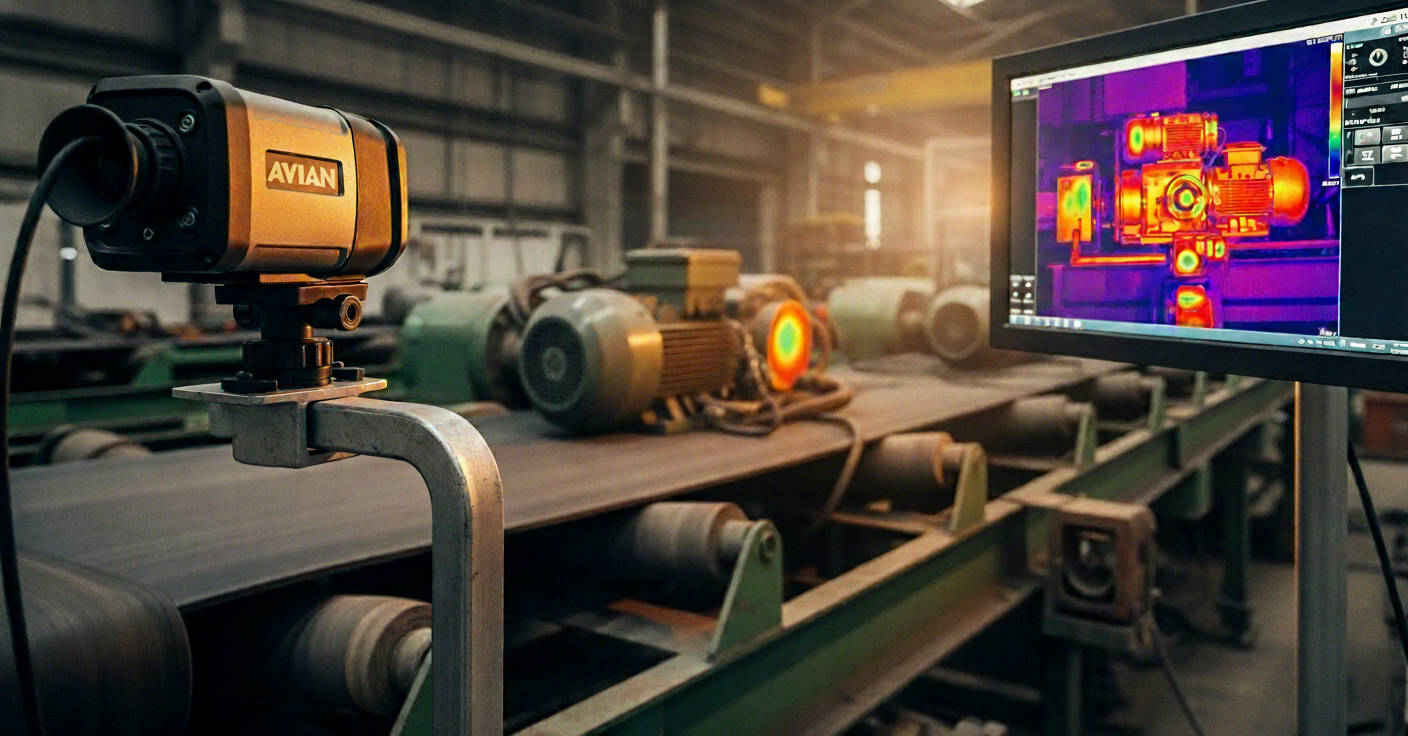
Our thermal cameras operate 24/7. They don't take breaks. They don't get tired on a night shift. They don't walk past a smoldering bale because they were checking the other side of the facility.
Every zone covered by an AVIAN camera is continuously monitored for thermal anomalies — hotspots that deviate from the learned baseline of your facility's normal temperature patterns.
At 2AM on a Saturday, the system is running at the same level of precision and vigilance as 2PM on a Tuesday. When a bale starts heating, we see it. When a waste pile develops a hotspot, we see it. When a conveyor bearing runs hot on an empty production line, we see it.
And we don't just see it — we act on it.
Instant alerts. The moment a thermal anomaly crosses our threshold, alerts go out via text message, phone call, and email. The right people know about it immediately, whether they're at home, asleep, or on the other side of the facility.
Automated response. For critical events, AVIAN can trigger PLC-integrated responses automatically. Conveyor shutdowns. Suppression activation. Diversion gates. No waiting for a human to see the alert, drive to the facility, and manually intervene.
Full event history. Every detected event is logged with thermal imagery, timestamps, and alert records. When your team arrives to investigate, they know exactly what happened, when, and where — not just "there was an alarm."
The 3AM Test
Here's a simple way to evaluate your facility's fire readiness. Ask yourself: if a battery enters thermal runaway in my bale storage at 3AM on a Sunday, what happens?
Walk through the scenario step by step.
How is the event detected? If the answer is "someone would smell it" or "the smoke detector would go off" — you've already lost the intervention window. Smoldering in baled material can go undetected for hours before producing enough smoke for a detector.
Who gets notified? If the answer depends on someone watching a camera feed or walking by the right area, the notification is unreliable. Human monitoring has gaps. Always.
What happens automatically? If nothing happens until a person arrives and makes a decision, your response time is measured in the time it takes for someone to wake up, check their phone, drive to the facility, locate the issue, and act. That could be 30 minutes. It could be an hour. The fire doesn't wait.
How quickly can the affected area be isolated? If you need to manually move material, shut down conveyors, or activate suppression, every minute counts. A fire that's addressed in the first five minutes is an incident. A fire that's addressed after sixty minutes is a catastrophe.
If your answers to these questions leave gaps, those gaps represent the hours where your facility is most vulnerable. And they probably represent the majority of the week.
Coverage Without Compromise
The solution isn't hiring a 24-hour fire watch team. That's expensive, unreliable, and doesn't scale.
The solution is continuous thermal monitoring that operates identically whether it's a busy Tuesday afternoon or a silent Sunday morning.
AVIAN's system is designed for facilities where the hazards change daily and the staffing changes hourly. Our adaptive algorithms learn your facility's thermal patterns — what's normal during production, what's normal during downtime, what's normal on a hot day versus a cold one. The baselines adjust automatically. The monitoring never stops.
For recycling facilities specifically, this means:
Tipping floor monitoring. New material arrives with unknown risks. Thermal cameras detect hotspots in incoming loads — batteries, heated organic material, chemical reactions — before they're pushed into processing or storage.
Conveyor and sorting line coverage. Even during off-hours when conveyors are idle, residual material and mechanical components can generate heat. Bearing failure, belt friction, and electrical faults don't require the line to be running.
Bale storage surveillance. The highest-risk area during unattended hours. Compressed material with embedded batteries or organic heat sources can take hours to reach ignition. Continuous thermal monitoring catches the temperature trend long before it becomes a fire.
Outdoor yard protection. Waste piles, staging areas, and transfer zones are often the least-monitored parts of a facility. Our cameras operate in direct sunlight, rain, dust, and darkness — conditions that defeat most other detection methods.
The Uncomfortable Math
Your facility is staffed maybe 10-16 hours a day, five or six days a week. That leaves 100+ hours per week with minimal or no on-site fire detection capability.
If your fire risk is constant — and in a recycling facility, it is — then you're unprotected for most of the week.
That's not a safety strategy. That's hope.
Thermal monitoring eliminates hope as a variable. It replaces human availability with continuous, automated detection that operates on the same schedule as the risk itself: always.
Your fires don't check the clock. Your monitoring shouldn't either.
Want to close the after-hours gap at your facility? Talk to our team about 24/7 thermal monitoring designed for your operation.
Neb Brennan