Back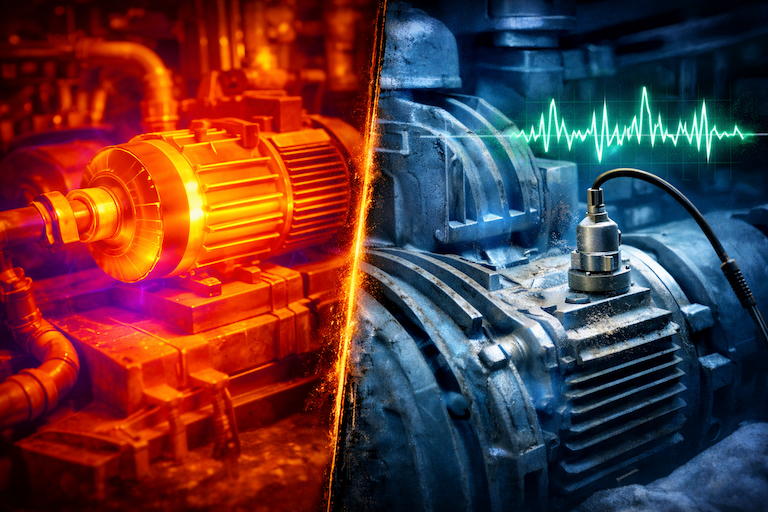
2026-02-01/Drew Hanover
Thermal Imaging vs. Vibration Sensors: What Vibration Monitoring Can't Tell You
Vibration monitoring has been the standard for predictive maintenance in heavy industry for decades. Companies like Waites and AssetWatch have built strong businesses around it. Attach a sensor to a motor. Measure vibration patterns. Detect imbalance, misalignment, or bearing wear before failure.
It works. We won't pretend otherwise.
But if vibration sensors are your only line of defense, you have significant blind spots. And in industries where fire risk is real — sawmills, planer mills, recycling facilities — those blind spots can be catastrophic.
What Vibration Does Well
Credit where it's due. Vibration analysis is excellent at diagnosing specific mechanical faults in rotating equipment.
A skilled vibration analyst can look at frequency data from a motor and tell you whether it's a bearing defect, shaft misalignment, mechanical looseness, or rotor imbalance. That level of diagnostic precision is genuinely impressive. Platforms like AssetWatch and Waites pair this data with certified analysts and AI to deliver actionable maintenance recommendations.
For a facility full of pumps, compressors, and turbines — a refinery, for instance — vibration monitoring is a clear first choice.
But most facilities aren't just pumps and compressors.
The Blind Spots
Here's what vibration sensors can't do.
They can't detect fire. This is the biggest one. Vibration sensors measure mechanical motion. They have no ability to detect a smoldering ember in your dust extraction system. No ability to spot a stuck board creating friction heat on your planer. No ability to see an electrical panel overheating before it arcs.
If your facility processes wood, handles combustible dust, or stores flammable materials, vibration monitoring gives you zero fire protection. Zero.
They monitor one asset at a time. Every vibration sensor is bolted to a single piece of equipment. Want to monitor 50 assets? You need 50 sensors, each individually installed, wired (or wirelessly connected), configured, and maintained.
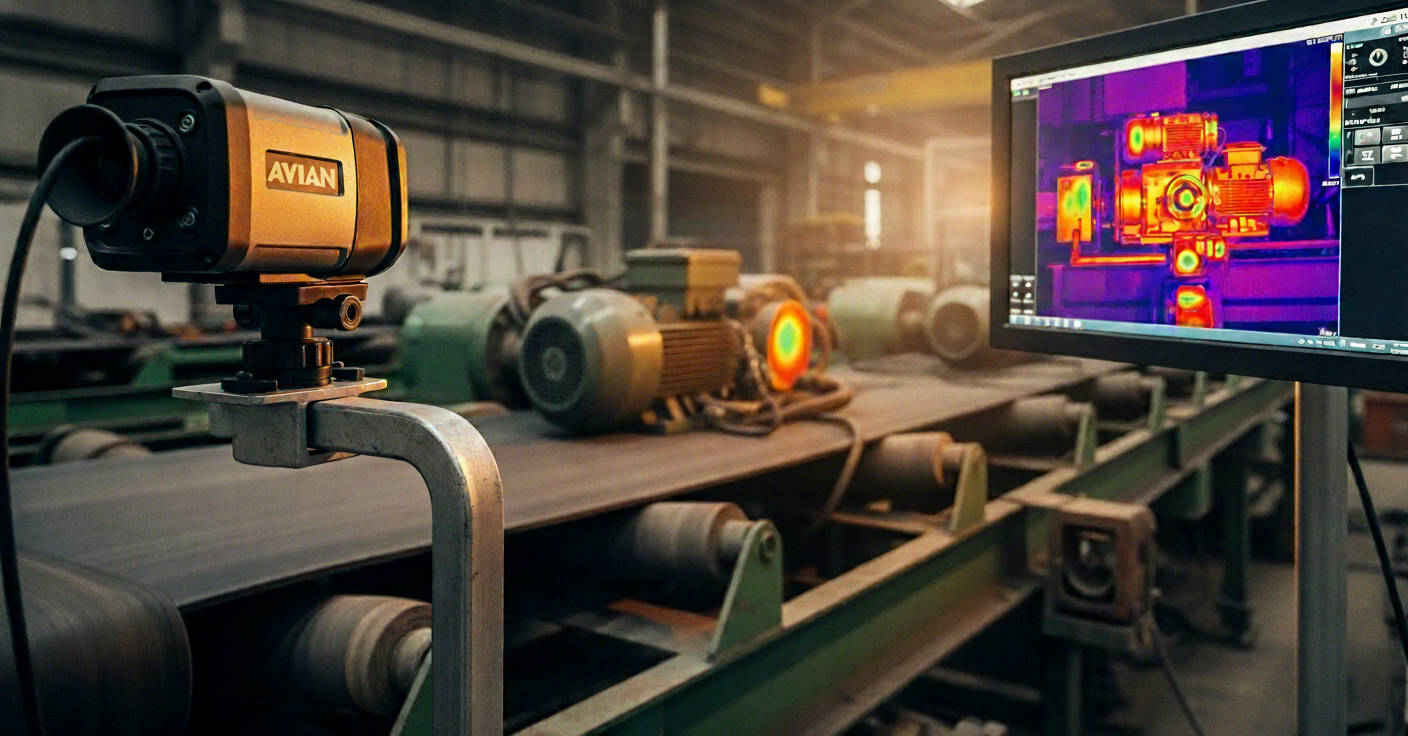
A single AVIAN thermal camera monitors an entire production zone. Every motor, bearing, belt, roller, duct, and electrical connection in its field of view — all from one device. We've seen single cameras cover areas that would require dozens of contact sensors to instrument.
They miss non-rotating equipment. Vibration analysis is designed for rotating machinery. But what about your dust collection ducting? Your electrical panels? Your material storage areas? Conveyor belts? Hydraulic systems?
These don't vibrate in ways that predict failure. But they absolutely generate heat when something goes wrong. Thermal imaging sees all of it.
They require physical contact. Sensors must be mounted directly on equipment. In many industrial environments — especially sawmills with heavy dust, moisture, and vibration — sensor installations can be fragile. Cables get damaged. Wireless connections drop. Sensors get buried under sawdust.
Thermal cameras mount on a wall or ceiling, away from the action. No physical contact with monitored equipment. No cables running across the production floor. No sensors to dig out of a pile of wood chips.
The Fire Prevention Gap
This is where the conversation gets serious.
Vibration monitoring companies position their products as predictive maintenance solutions. And they are. But predictive maintenance is only one half of the equation for industries that process combustible materials.
The other half is fire prevention.
A planer mill can lose more from a single fire than from a year of equipment failures combined. We've seen it happen. A stuck board creates an ember. The dust extraction system carries it into the ductwork. Without thermal monitoring, nobody knows until the duct is engulfed.
We caught exactly this scenario at a customer site. The first sign was a stuck board detected by our camera — a rapid temperature spike to 100°C. An hour later, a separate camera 50 meters away detected heat on the ceiling — an ember had traveled through the ductwork and ignited accumulated material. Our adaptive algorithm flagged it at just 75°C. Within a minute, temperatures exceeded 115°C on the outside of the metal duct.
The customer's words: "Without your system, we would have had a disaster."
No vibration sensor on Earth would have caught that. Not because vibration monitoring is bad technology. Because fire isn't a vibration problem.
One Sensor, Two Solutions
Here's what makes thermal monitoring unique in the predictive maintenance landscape.
A single AVIAN camera solves two problems simultaneously:
-
Predictive maintenance.Temperature trend analysis across all visible equipment detects bearing degradation, motor overload, belt wear, and hydraulic issues — the same failure modes vibration sensors target, but without per-asset instrumentation.
-
Fire prevention.The same camera detects sparks, embers, friction hotspots, electrical faults, and smoldering material — failure modes that vibration sensors don't even attempt to address.
You don't need two separate systems. You don't need vibration sensors on every motor AND fire detection in every zone. A thermal monitoring system covers both.
"But Thermal Is a Late-Stage Indicator"
This is the most common pushback we hear from vibration monitoring advocates. The argument goes like this: heat is a symptom, not a cause. By the time something is hot enough to detect thermally, the failure is already well underway.
It's a fair point for handheld thermal inspection. If you're doing a walkthrough with a FLIR camera once a month, yes — you're only catching problems that have already progressed significantly.
But that argument falls apart with continuous thermal monitoring.
Our cameras take measurements 25 times per second. Our algorithms analyze every pixel against historical baselines. We don't wait for something to hit 200°C. We detect a 5°C deviation from a component's normal operating temperature and flag it immediately.
That's not late-stage detection. That's catching a bearing issue days before it would show up on a vibration sensor — because the temperature change from increased friction appears before the vibration signature changes measurably.
We've seen this play out at our installations. Subtle thermal trends that preceded vibration-detectable faults by days or even weeks. The idea that thermal is always "late" is based on outdated assumptions about periodic inspection, not continuous AI-powered monitoring.
When to Use What
We're not here to tell you to rip out your vibration sensors. If you have a mature vibration monitoring program running on critical rotating assets, keep it.
But ask yourself these questions:
- Do you process combustible materials? If yes, you need thermal monitoring. Vibration doesn't protect against fire.
- Do you have non-rotating equipment you'd like to monitor? Electrical panels, ductwork, hydraulic systems, storage areas — thermal covers these. Vibration doesn't.
- Are you spending heavily to instrument every individual asset? A thermal camera covers an entire zone. Consider where thermal monitoring gives you broader coverage at lower per-asset cost.
- Do you lack coverage after hours? Both systems run 24/7. But a thermal system also gives you fire protection overnight — the most dangerous window for facilities running lean night shifts or completely unattended.
For many of our customers in the wood processing and recycling industries, thermal monitoring is the primary predictive maintenance tool. It covers the broadest range of failure modes, provides fire protection that no other technology offers, and does it all from a single device per zone.
The Bottom Line
Vibration monitoring is proven technology for rotating machinery diagnostics. We respect what companies like Waites and AssetWatch deliver for their customers.
But if your facility faces fire risk — and if you run a sawmill, planer mill, or recycling plant, it does — vibration monitoring alone leaves a dangerous gap. It sees half the picture.
Thermal monitoring sees the rest. The ember in the ductwork. The overheating electrical panel. The belt wearing unevenly. The motor that's slowly dying. And it sees all of it from a single camera that installs in minutes and starts protecting your operation immediately.
Your equipment fails in heat. Your fires start with heat. The sensor that measures heat is the one that catches both.
Want to see how thermal monitoring complements or replaces your current program? Talk to our team about a facility assessment.
Drew Hanover
CTO & Co-Founder