Back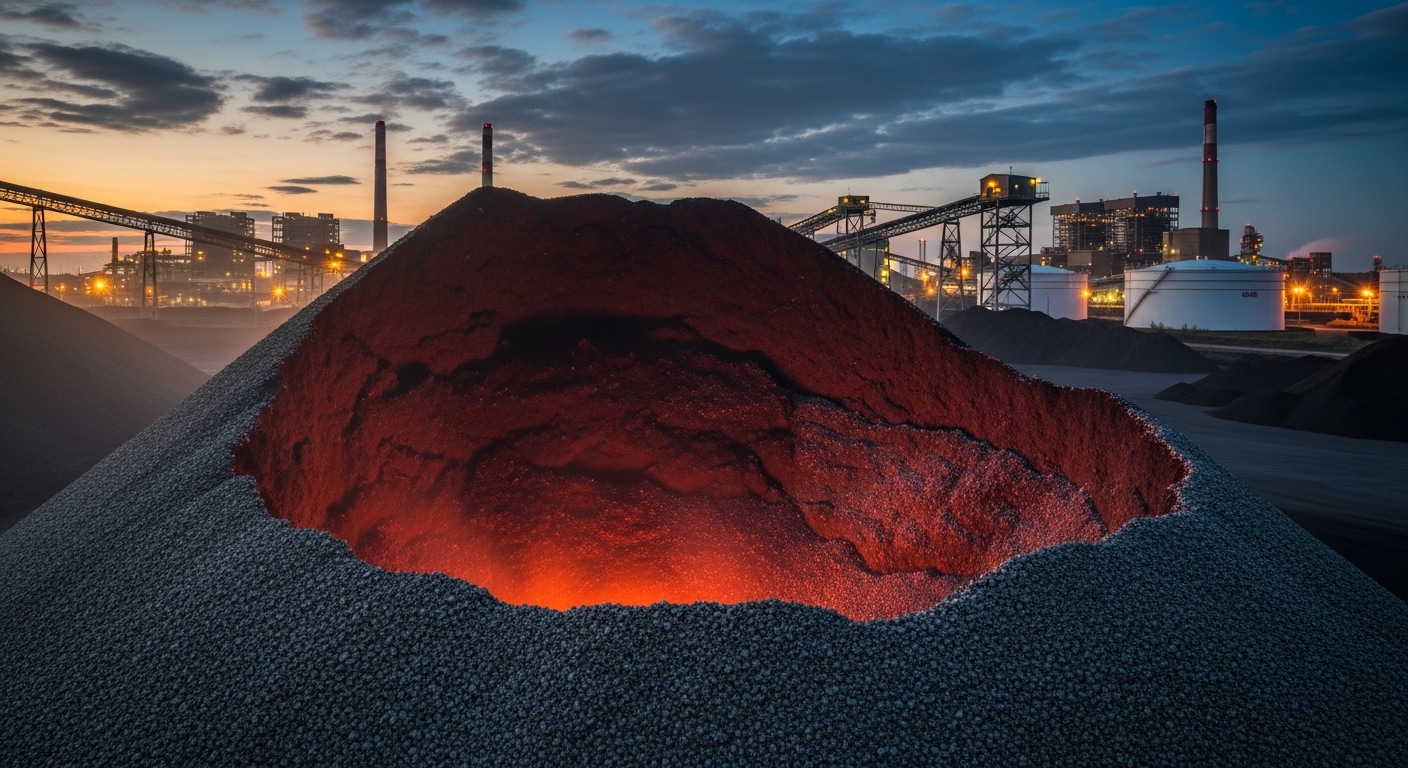
2026-02-10/Drew Hanover
The Pile Is Already Burning
By the time you see smoke, you're already behind.
That's the defining fact about stockpile fires. Coal piles, biomass heaps, bark mountains, mineral and fertilizer storage — they don't start from the outside. They start from within. Heat builds slowly. Microbial activity, oxidation, friction, compressed air pockets. For days or weeks, nothing visible happens. Then conditions align, oxygen reaches the hot core, and a pile the size of a building turns into an uncontrollable fire within the hour.
The most dangerous thing about these fires is that they look safe until they aren't.
What's Actually Happening Inside the Pile
Spontaneous combustion in bulk material storage isn't a freak event. It's chemistry.
Coal oxidizes on its own when exposed to air. The reaction generates heat. That heat accelerates the reaction. In a large pile, the material in the center can't shed that heat fast enough, so the temperature climbs. Volatile gases — carbon monoxide, methane, hydrogen sulfide — accumulate in the interior. At some point, the pile reaches a critical threshold. It doesn't need a spark from outside. It lights itself.
Biomass works similarly. Wood chips, bark, sawdust, and agricultural residues all contain bacteria that remain active during storage, producing heat as a byproduct of decomposition. A pile of wood chips can generate significant internal temperatures within days of being formed. Add dry weather, wind, and the pile becomes a pressure cooker with no release valve.
Minerals like sulfur and certain fertilizers bring additional hazards. Sulfur piles have burned at ports from Australia to Canada. When they ignite, they release sulfur dioxide — a toxic gas that triggers HAZMAT responses across entire municipalities.
The material varies. The underlying danger is the same: large quantities of bulk material store heat. That heat eventually finds a way out.
The Numbers Are Hard to Ignore
The United States Energy Information Administration has documented that coal-fired facilities hold hundreds of millions of tons of coal in open-air and enclosed stockpiles at any given time. Research published in the journal Fire in 2023 found that closed coal bunkers at power stations experience fires with enough regularity to be described as a systemic concern — not an anomaly. The study identified that heat accumulation in confined spaces, combined with continuous oxidation, creates conditions where ignition is not a question of if but when.
For biomass, the statistics are similarly stark. Large-scale biomass handling facilities report multiple thermal incidents per year. Spontaneous combustion accounts for the majority of fires at wood chip and bark storage sites globally.
The insurance industry has noticed. Fire frequency at facilities storing bulk organic material has climbed steadily. Claims are larger. Premiums are higher. Some facilities are finding coverage impossible to obtain.
Recent Fires: What Actually Happened
These aren't hypothetical scenarios. They're last year's headlines.
Sexton Lumber, Lethbridge, Newfoundland — September 2025
A 100,000-tonne bark pile caught fire. The cause: spontaneous combustion. Bacteria inside the pile had been generating heat for an unknown period before the pile was exposed to oxygen. When conditions aligned, the bark went from stable to fully ablaze in under 45 minutes.
Two water bombers, a bucketing helicopter, and ground crews responded. The fire resisted aerial bombardment — it had to be physically dug up and wetted down. Evacuation orders were issued for surrounding residential areas. Residents were told to stay indoors. A firebreak was built around the perimeter. The fire burned for days.
There was no advance warning. The pile looked fine at noon.
Omaha Track Facility, Superior, Wisconsin — July 2024
A 30-foot wood chip pile measuring 300 feet by 80 feet began smoking at 4:13 AM. Spontaneous combustion, again. By the time crews arrived, the pile was actively burning.
Twenty-one firefighters from four departments worked for fourteen hours. They used 85,000 gallons of water and 40 gallons of foam. Heavy equipment operators spent the entire day moving material away from the fire while crews kept it wet.
No injuries. No spread to structures. But 14 hours, four departments, and 85,000 gallons for one pile of wood chips.
Westshore Terminals, Delta, British Columbia — December 2024
Canada's largest coal export facility — handling approximately 33 million tonnes annually — suffered a conveyor and stacker fire. Thick black smoke was visible from the Tsawwassen ferry terminal across the water. Both Westshore and the neighboring GCT Deltaport shut down operations. The fire was extinguished without injuries, but the operational disruption rippled through coal supply chains during a period of already-strained global capacity.
Kwinana Port, Western Australia — February 2024
A fire at Nutrien's fertilizer storage facility started in a conveyor belt and spread to sheds containing sulfur and granular fertilizer. More than 50 firefighters responded. Eleven workers were evacuated. HAZMAT warnings were issued across multiple suburbs as sulfur dioxide spread northeast with the wind. The affected communities were told to close their windows. The damaged infrastructure — import conveyors, transfer towers, storage sheds — represented a significant portion of a facility that handles 1.6 million tonnes of fertilizer annually.
Hibbard Renewable Energy Center, Duluth, Minnesota — June 2025
A fire broke out in a 20,000 square foot wood biomass storage building at 2:50 PM. The facility's deluge suppression system activated and contained the fire until firefighters arrived. Power generation was not impacted.
This one was contained. But it was contained because the suppression system worked. Which raises the obvious question: what happens when it doesn't?
Phichit Province, Thailand — 2024
A fire at a 26-megawatt biomass power plant consumed more than 1,000 tonnes of compressed fuel made from rice husks, sugarcane leaves, and wood chips. The facility supplies electricity to Thailand's national grid. Cause unknown. Loss of fuel inventory required operational changes across the facility.
POET Bioprocessing Facility, Emmetsburg, Iowa — February 2025
A fire in the stackyard destroyed biomass bales and continued burning for three days. No cause was officially confirmed.
What Fighting These Fires Actually Costs
The headline is always the fire. The real cost is everything else.
Firefighting resources. The Wisconsin fire consumed 85,000 gallons of water over 14 hours with four departments. Multiply that by the hundreds of similar incidents that occur across the continent each year — the resource demand is enormous. Volunteer fire departments in rural areas that house many of these facilities respond knowing they may be there all day.
Environmental discharge. The water used to fight a stockpile fire doesn't evaporate. It picks up heavy metals, hydrocarbons, and combustion byproducts as it runs through the pile. It enters drainage systems, waterways, and groundwater. Regulators increasingly require containment berms and remediation plans following major industrial fire events. The cleanup often costs more than the firefighting.
Air quality. Burning coal piles produce sulfur dioxide, nitrogen oxides, fine particulate matter, and carbon monoxide. In 2024, the underground fire at Grosvenor Coal Mine in Queensland, Australia forced 9,500 residents in the nearby town of Moranbah to stay indoors. Air quality monitoring sensors were deployed across the town. The smoke lasted days. When the material involved is fertilizer or industrial chemicals, the air quality consequences are worse.
Operational downtime. Westshore Terminals handles 33 million tonnes annually. Even a short shutdown represents enormous economic loss. Biomass plants that lose their fuel inventory must pause generation. Coal-fired facilities that lose stockpile access face production shortfalls they can't quickly recover from.
Insurance. Premiums for facilities storing bulk combustible materials have risen sharply over the past several years as claims frequency increases. Some operators are finding coverage impossible to obtain or maintain.
The fires that don't make national news still cost money. A contained incident with no injuries and no structural loss still costs firefighting hours, response logistics, and regulatory follow-up.
Why Thermal Monitoring Changes Everything
The core problem with stockpile fires is that by the time they're visible, they're already mature.
The chemistry that leads to combustion takes place below the surface, over hours and days. A pile can maintain a dangerous internal temperature — 70°C, 80°C, higher — with no visible surface sign. When external conditions finally allow that internal heat to ignite, the transition from smoldering to active fire can happen in minutes.
Human inspection can't solve this. You can walk the perimeter of a coal pile every four hours and still miss the interior temperature spike that precedes ignition by 18 hours. The same is true for biomass, bark, and mineral stockpiles. Visual monitoring is insufficient. Spot-checking with handheld thermal cameras is better — but it covers only the areas you check, at the moments you check them.
What actually works is continuous infrared monitoring across the full surface of the pile, operating around the clock.
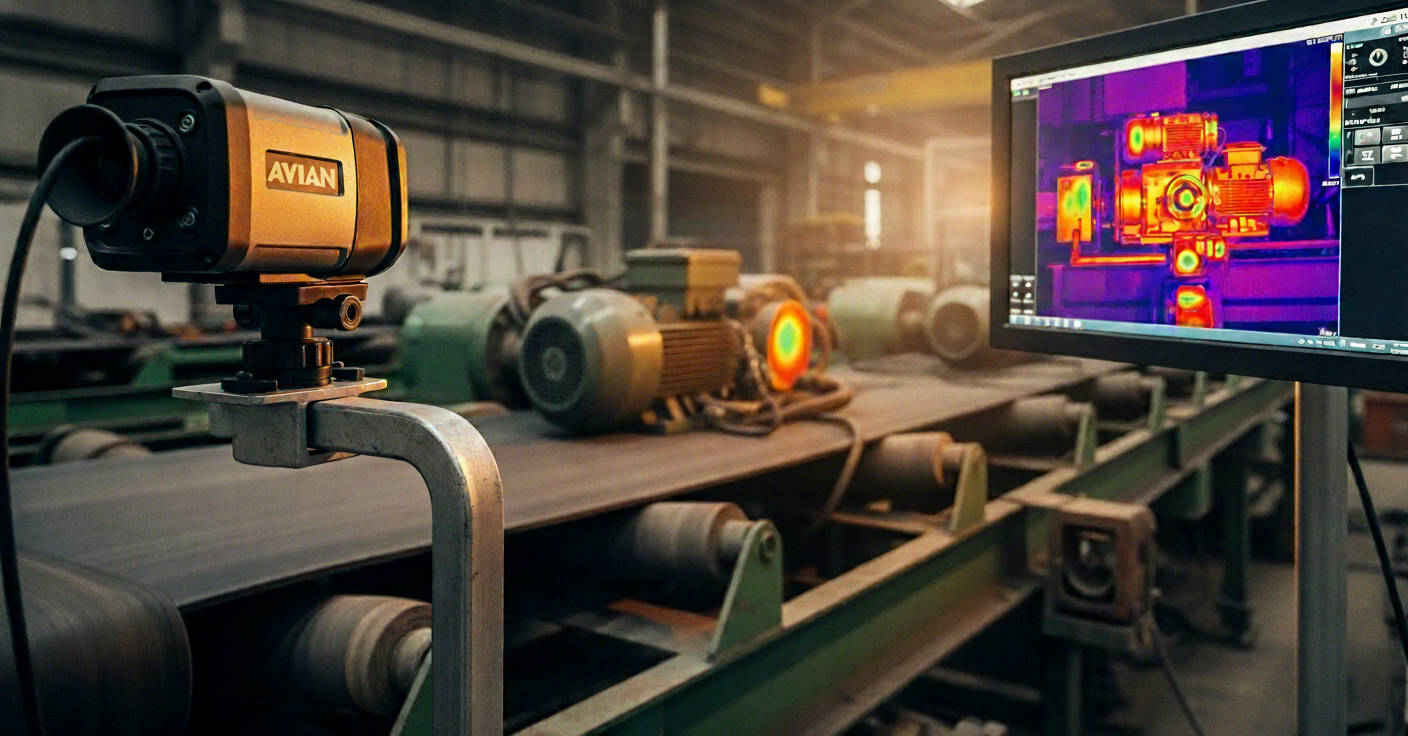
Modern fixed-mount thermal cameras can scan stockpile surfaces with millidegree sensitivity, covering areas measured in hundreds of meters, continuously. They detect anomalous heat signatures — elevated surface temperatures, patterns that indicate subsurface heating — and trigger alerts before conditions develop into ignition.
This isn't science fiction. The Duluth biomass facility had a suppression system. Czech coal mines have deployed fixed thermal arrays across 800-meter storage yards. The technology exists. The question is whether it's deployed systematically or reactively.
What AVIAN Does Differently
AVIAN was built for exactly this environment.
Our thermal cameras mount permanently on fixed masts or facility infrastructure and scan stockpiles continuously — 24 hours a day, seven days a week, without exception. There's no shift change. There's no one going home at 5 PM. The cameras operate through rain, fog, smoke, and darkness. Temperature sensitivity allows detection of anomalies invisible to standard cameras or human observation.
When our system identifies a temperature pattern consistent with subsurface heating or early-stage surface ignition, it sends an alert immediately. The alert includes the exact location within the pile, the thermal image, and the temperature data. Operators can assess and respond while there's still time to intervene.
In a sawmill context, we've caught embers in duct systems 50 meters from the source before a fire developed. In stockpile environments, the same principle applies at a larger scale: the anomaly is detectable long before it becomes a crisis.
For facilities with suppression infrastructure, AVIAN integrates directly with PLCs to trigger automated response — sprinkler activation, diversion systems, operational shutdowns — without requiring a human to be at a monitor at 3 AM.
The Sexton lumber pile gave no warning. It was stable at noon and burning at 12:45. A continuous thermal monitoring system would have detected the internal heat signature building long before oxygen reached the core. The outcome of that evacuation could have been different.
The Wisconsin fire started at 4:13 AM. No one was watching. A monitoring system would have triggered an alert while the fire was still a manageable thermal event rather than a 30-foot pile requiring four departments and 85,000 gallons.
The pattern is the same across every incident. The fire was preventable at the stage before it became visible. The window to act is thermal — and it's only visible if you're equipped to see it.
The Argument for Acting Before the Smoke Appears
Most facility operators know spontaneous combustion is a risk. They have safety plans. They do periodic inspections. They maintain operational protocols.
Those protocols assume the problem will show itself in time to respond.
It often doesn't.
The 45-minute window at Sexton Lumber wasn't enough to protect surrounding residents. The 4 AM start at the Wisconsin facility meant no one was present to notice. The Kwinana fire spread from a conveyor to sulfur storage before crews could contain it.
Continuous thermal monitoring doesn't eliminate the underlying risk — biomass will still self-heat, coal will still oxidize, sulfur will still behave as sulfur. But it removes the invisibility. A pile monitored around the clock cannot surprise you with a fully developed fire. You'll see the anomaly while it's still a temperature reading on a screen, not a fire requiring evacuation orders and water bombers.
That's the difference between an alert at 2 AM and a fire at noon.
If you operate a facility that stores bulk materials — coal, biomass, bark, agricultural residue, fertilizers, or other combustible commodities — reach out to our team. We'll walk through what continuous thermal monitoring looks like in your specific environment and what early detection would have meant for the incidents described here.
Drew Hanover
CTO & Co-Founder