Back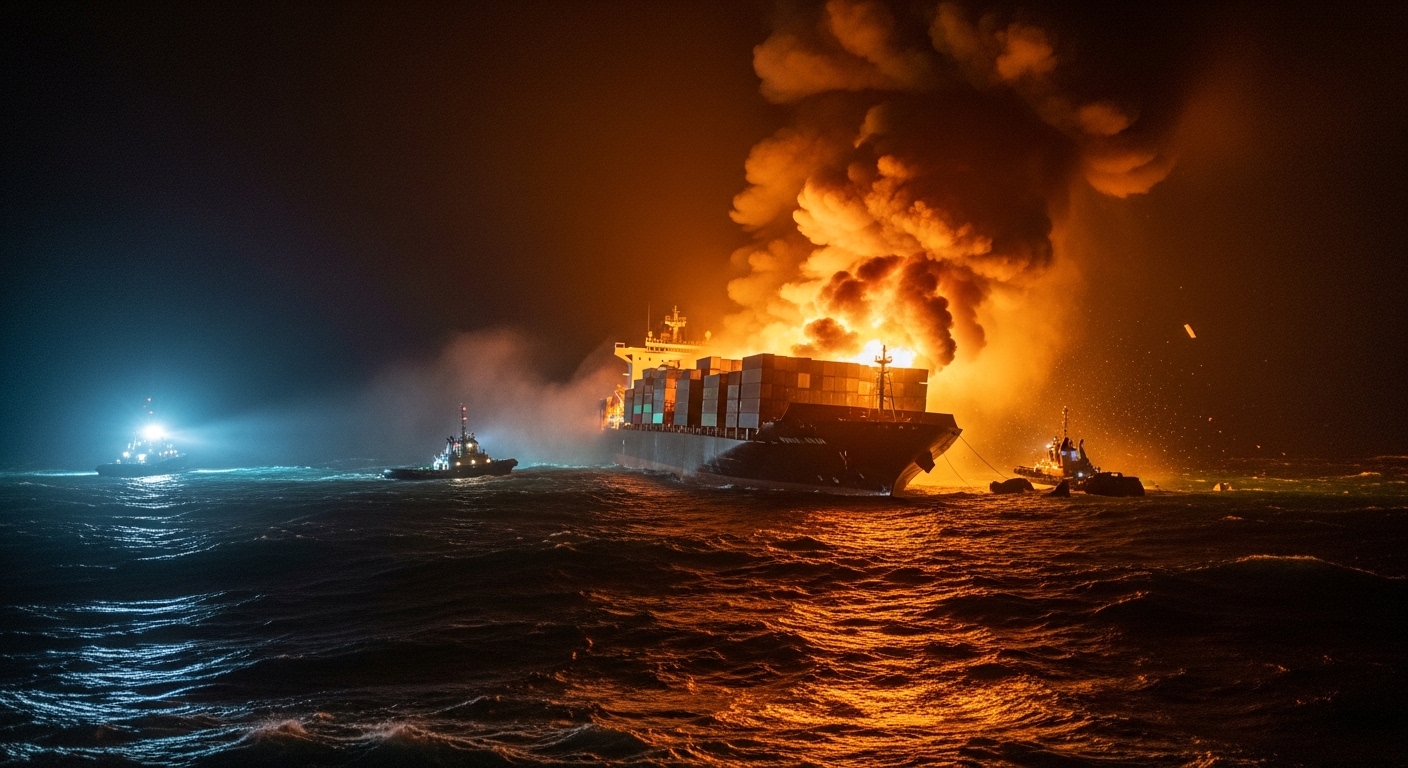
2025-12-30/Drew Hanover
Fire at Sea: The Growing Threat to Freighter Ships
A serious fire erupts on a container ship every nine days.
That number comes from Lloyd's List Intelligence casualty data. It doesn't include every incident — only the ones serious enough to register. The full picture is worse.
In 2024, the maritime industry recorded approximately 250 fire and explosion incidents on ships worldwide. That's a 20% increase from the year before, and the highest level in a decade. Fires at sea are not getting rarer. They are getting more frequent, and the contributing factors are piling up faster than the industry can address them.
Why Ships Are Different
A fire on land is bad. A fire on a ship is a different category of disaster.
When a building catches fire, firefighters can surround it. They can cut ventilation. They can evacuate occupants and retreat to a safe distance. The structure stays in one place.
Ships don't stay in one place. They are surrounded by water, which sounds helpful until you realize that flooding a ship to fight a fire can destabilize and sink it. Compartments fill with smoke. Radio communications fail — steel hulls reflect signals. The crew, often 20 to 30 people, may be hundreds of miles from the nearest port, with no external help coming for hours.
Of the ten most lethal fires in American history, four occurred on ships. Those four incidents alone killed 2,138 people.
Modern container ships make the problem harder. A single large vessel carries 10,000 to 24,000 containers. No crew can physically inspect what's in each one. The ship's manifest says "electronic components." The container might hold undeclared lithium-ion batteries, calcium hypochlorite, or any number of chemicals that become volatile under heat and pressure at sea.
The Cargo That Starts Fires
Three types of cargo create outsized fire risk on freighters: liquefied natural gas (LNG), coal, and undeclared dangerous goods.
LNG carriers transport natural gas cooled to -162°C (-260°F) in liquid form. At that temperature, a small leak doesn't just spill — it vaporizes instantly. That invisible cloud drifts with the wind until it hits an ignition source: a spark, a hot surface, static electricity. Then it explodes.
The risk became concrete in March 2026, when the Russian LNG carrier Arctic Metagaz exploded and caught fire in the Mediterranean Sea, approximately 150 nautical miles southeast of Malta. The ship was carrying around 62,000 cubic meters of LNG cargo. All 30 crew members were rescued, but two suffered severe burns, and the vessel eventually sank. Towing operations failed in the rough weather that followed.
The incident brought renewed attention to what industry insiders have known for years: the global LNG fleet is aging, expanding, and operating under conditions that don't always allow for proper inspection or maintenance.
Coal poses a different but equally serious threat. Coal self-heats. The oxidation process that has always made coal useful for burning doesn't stop when you load it onto a ship — it continues slowly, silently, in the hold.
On November 27, 2024, a bulk carrier hauling coking coal off the coast of Virginia experienced consecutive explosions in two forward cargo holds. Methane gas — a byproduct of coal oxidation — had accumulated to explosive concentrations. Five additional holds were also showing methane levels approaching the lower explosive limit. The cargo declarations had failed to disclose the coal's methane-producing properties, and the crew had not followed ventilation protocols.
In August 2025, the coal carrier W-Sapphire exploded near the Port of Baltimore, sending an 80-meter smoke plume into the air. Investigators are still probing whether spontaneous combustion or coal dust ignition triggered the blast.
Indonesian coal is a particular concern — it frequently self-heats without being properly declared as such. The IMSBC Code, the international standard governing solid bulk cargo, prohibits loading coal above 55°C. Compliance is inconsistent.
Undeclared dangerous goods are the most invisible threat. A 2024 International Union of Marine Insurance report found that misdeclared cargo is the probable cause of approximately 25% of all major container ship fires — and that share has been growing.
The method is straightforward: shippers falsify manifests to avoid the surcharges and regulations that come with hazardous material classification. Lithium-ion batteries get labeled "electronic components." Calcium hypochlorite — which reacts violently with water — gets labeled "pool chemicals." Aluminum phosphide, which releases toxic phosphine gas when wet, shows up as "synthetic resin."
Less than 2% of containers are physically inspected. Spot checks find significant discrepancies in over 30% of the containers they examine. The math is stark.
In November 2025, a fire at the Port of Los Angeles burned approximately 100 containers aboard the One Henry Hudson and triggered a mid-deck explosion. Many of those containers held undeclared hazardous materials including suspected lithium-ion batteries. In 2025, India formally raised the alarm at the International Maritime Organization, requesting stronger rules after a wave of fires linked to undeclared batteries.
COVID Left Ships Exposed
Before LNG carriers and lithium battery fires dominated headlines, COVID-19 created a different kind of fire risk: ships that couldn't move.
By September 2021, 56 cargo ships sat at anchor off Los Angeles and Long Beach, the most ever recorded. At the Port of Yantian in China — the fourth-largest container port in the world — a COVID outbreak backed up 300,000 shipping containers. Ships waited offshore for days, then weeks.
Extended idle time is dangerous. Systems go unmaintained. Crew rotations get disrupted — at the peak of COVID, approximately 100,000 seafarers were stranded at sea past their contract end dates, with another 100,000 unable to board ships for work. Fatigued, overtasked crews make mistakes.
A fire that might have been caught at its earliest stage — a warning alarm, a routine check — gets missed when a crew is stretched past capacity. The ship is also running auxiliary engines continuously while at anchor, increasing wear on machinery that can be a fire ignition source.
COVID didn't cause ship fires directly. But it created the conditions that make them more likely: deferred maintenance, fatigued crews, extended idle times, and disrupted inspection schedules.
Iran and the Strait of Hormuz
A more recent disruption is reshaping global shipping in ways that create similar fire risks.
By March 2026, traffic through the Strait of Hormuz had dropped to just eight ships per day — a near-complete standstill. At least 150 to 200 vessels were stranded in the Gulf waters, unable to transit safely. The Honduran-flagged Athe Nova caught fire after being struck by two drones. The Malta-flagged Safeen Prestige was damaged by a projectile and abandoned. The Stena Imperative, a U.S.-flagged vessel, sustained aerial impacts while berthed.
Major carriers suspended new bookings to Middle Eastern ports. Maersk alone had 10 vessels stranded in the Gulf. Ships that can't move face the same problem they faced during COVID: deferred maintenance, crew fatigue, and continuous auxiliary engine operation.
The risk compound with time. A ship stranded for five days is more vulnerable than a ship stranded for one. Cargo degrades. Temperature control systems strain. Dangerous goods that were stable on loading day become less so as weeks pass.
The Strait of Hormuz carries roughly 20% of the world's LNG trade. It is the transit point for energy cargo from Qatar, the UAE, and Kuwait. When ships cannot move through it freely, the pressure builds at both ends of the route — and under pressure, dangerous cargo becomes more dangerous.
The March 2026 LPG Incident at Puerto Quetzal
On March 4, 2026, the Norwegian-flagged LPG carrier NICE was discharging cargo at the Zeta Gas terminal in Puerto Quetzal, Guatemala, when a mechanical failure in a discharge relief valve caused pressurized liquefied petroleum gas to escape.
The release lasted approximately 60 seconds. Emergency protocols activated immediately. The port suspended operations, restricted vessel movement, and evacuated personnel. No injuries were reported. The valve was repaired and operations resumed.
The incident is significant precisely because it went well. Sixty seconds of uncontrolled LPG release, caught and contained. A relief valve failure that was isolated before the gas cloud found an ignition source.
That's the best-case scenario for a gas carrier leak. It requires the failure to be simple and addressable, occurring in daylight, at a pier, with experienced emergency response teams on standby.
At sea, the conditions are different. The distance from port is different. The access is different. And the chance of a 60-second containment window is much smaller.
Detection Before Ignition
What connects every scenario above — the coal hold accumulating methane, the misdeclared lithium battery entering thermal runaway in a container, the LNG system running warmer than it should — is that none of them are instantaneous.
Heat precedes fire. Always.
Coal oxidation raises hold temperatures before methane reaches explosive concentrations. A lithium-ion cell entering thermal runaway spikes to over 100°C before it ignites surrounding materials. A mechanical failure in a gas system generates friction heat before a seal fails. An engine room fire usually starts with an overheated component — a pump, a bearing, an electrical panel — before it becomes a fire.
The gap between "elevated temperature" and "visible fire" is the only window in which an intervention is easy. After that window closes, the options are abandon ship, fight an extremely dangerous shipboard fire, or watch a vessel and its cargo become a loss.
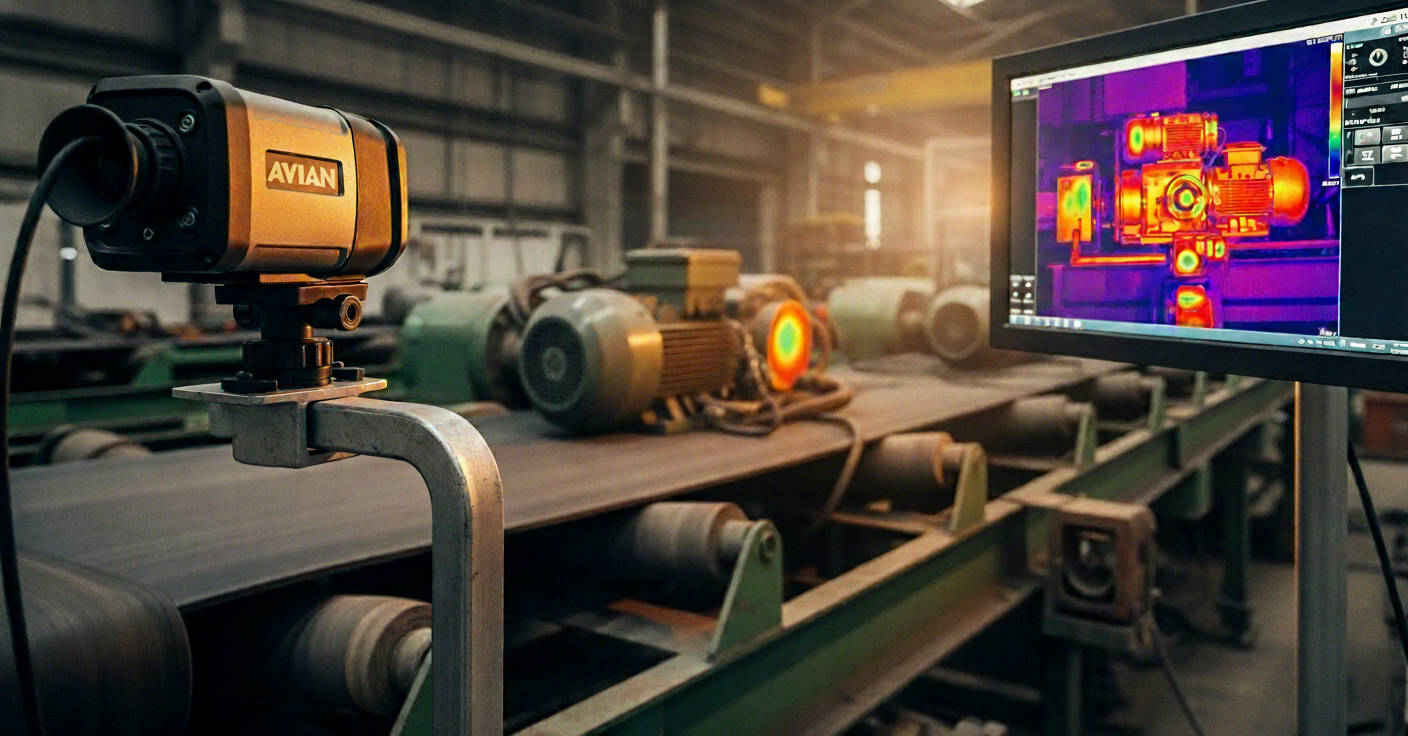
Thermal monitoring systems have historically focused on industrial facilities — sawmills, recycling plants, warehouses. But the same physics applies at sea. Continuous monitoring of cargo holds, engine rooms, and high-risk compartments turns the invisible into the visible. An anomaly that would have gone undetected for hours gets flagged in minutes.
Fire is expensive. At sea, it's lethal. The infrastructure to catch it before it starts exists now. The industry's adoption of that infrastructure remains far behind the pace of the risk.
If you operate or insure industrial facilities where thermal hazards are a concern — on land or at sea — reach out to our team. We build systems that see what the human eye cannot.
Drew Hanover
CTO & Co-Founder